

Feeling Lucky
Are we born lucky or unlucky? Or are we born innocent, curious, open, loving, and defenseless?
As we move through life, our defenses are mustered by how our family, school, religions, governments, and all sorts of other elements begin to influence our beliefs about the world we live in. The portal of our openness to all that we could receive from God begins to grow smaller. The truth is that we are all born with the capacity to have all that exists within us and outside of us.
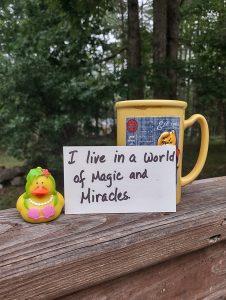 Sacred scriptures say that we are created in the image of God, or the All That Is. Can a sacred entity be unlucky or lucky? For many centuries, humans have seen good fortune as an external experience. If the guy next door came into some money or he won at the races, he was considered lucky, implying that he had no control over these events. It was like a fairy godmother/godfather came and waved a magic wand over “certain special” people and they miraculously came into good fortune.
Rabindranath Tagore (1861-1941) — poet, philosopher, and polymath — once said, “The winds of grace are always blowing, but it is you that must raise your sail.” It means that luck, good fortune, exists like energy. (Sound waves exist whether we see them or not.) And it is up to us to build the sail to catch the wind, so to speak.
In 1948, a movie called “Luck of the Irish,” with Tyrone Power and Anne Baxter, came out. The setting was the Irish countryside, where all sorts of “magic” occurred, including dealings with a grateful leprechaun. All my life, I’ve heard people use the phrase, “she/he has the luck of the Irish,” without quite knowing what it meant. It implies that only certain people can become Lucky. Then in 2016, Neil Farber, MD, PhD, wrote an article in Psychology Today, “8 Habits of Highly Lucky People,” in which he made the case for having some control over how lucky we can be. He said people who seem to be lucky usually practice mindfulness, are proactive, opportunistic, insightful, flexible, optimistic, and resilient, and they think outside the box. Certain focused characteristics allow people to tap into that thing called luck.
Gay Hendricks, in his 2020 book, “Conscious Luck,” shares the four core shifts in our consciousness, and four daily practices that allow us to be lucky. These teach you how to: 1) plant the seeds of luck in your own psyche, 2) remove unlucky programming (including lifting “curses”), 3) move at your Essence Pace, and 4) practice Radical Gratitude, and much more. It’s an amazing book that demands a high level of commitment to let go of limiting beliefs related to luck. Beliefs such as “only educated people are lucky” or “I’ll never be lucky, our family was very unlucky.” Getting rid of the generations of myths and beliefs that keep you from experiencing the “winds of grace,” as Tagore says, is a huge challenge.
I learned recently that we can only receive at the level of our feeling of safety. If we don’t feel safe receiving love because of some unfortunate experience with love in our past, then no matter who comes along who may be able and willing to give us the world, we will not be able to see it or receive it. It’s a fact that about 90% of the people who win big in the lottery don’t have much of it left within 18 months of winning. They either spend it, give it away, or lose it. Why is that? It’s possible that they had an underlying feeling of shame about having so much money, or they had attitudes about money that kept them from being able to hold onto their new fortune, like thinking that rich people are selfish, or get it in unethical ways. Not wanting to be seen as either of these, the unconscious mind can trick us into staying small, even when we know there’s a possibility of winning big if we buy the ticket.
Luck can be cultivated with practice. We can become active receivers. Like the dial on a radio, we can keep tuning in to get rid of any static, so that we are open to receiving the abundance that is all around us. Our luck can change, and we don’t have to be Irish!
Have a gorgeous day!
Mentone Fall Festival Returns Saturday, Oct. 17
Lots of Good Food Choices and Opportunities to Sponsor Mentone is preparing to welcome thousands of visitors as the Mentone Fall Festival returns Saturday, Oct. 17, for a full day of art, music, food, and » Read More

High Temps? No Problem. Try These Cool Recipes
We’ve been spoiled most of the summer with rainy days, cloud cover, and highs in the 70s and low 80s. But today when I walked outside, I realized that luck might have run out. Corn » Read More

Valley Head Women’s Club Awards Scholarships
The Valley Head Area Women’s Club awarded two scholarships to the Valley Head High School Class of 2026. This year, the scholarships were increased in memory of JoAnn Phillips to a total value of $800 » Read More

A Bit of Our Town’s History
I decided to give you all a brief history lesson on our beautiful town this month. I even discovered a new fact or two myself. Valley Head was officially incorporated in 1922 and continues to » Read More