

The U.S. Navy Flag Explained

The flag of the United States Navy, often a source of confusion for the general public, is a powerful symbol of the nation’s maritime power and heritage. Unlike the more commonly recognized flags of the Army, Marine Corps, and Air Force, the Navy’s official flag is not the one most people associate with naval vessels. This article explores the history, design, and significance of the U.S. Navy flag and other important flags used by the service.
 A Brief History
The U.S. Navy did not have an official flag for many years. Early naval vessels flew the national ensign (the Stars and Stripes) to identify their nationality. However, as the service grew and its missions expanded, there was a need for a unique flag to represent the Navy itself. The current official flag of the U.S. Navy was formally adopted on April 24, 1959. Its design reflected the Navy’s history and mission.
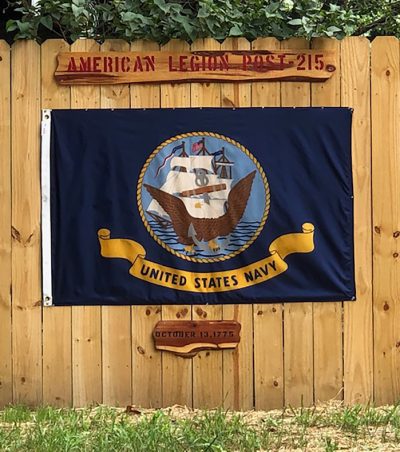
The official U.S. Navy flag is a distinctive and symbolic design. It consists of a dark blue field with the seal of the Department of the Navy in the center.
The seal is a prominent feature of the flag. It depicts an eagle with its wings spread, perched on an anchor, with a Constitution-class frigate sailing on the sea below.
This seal was originally adopted in 1957. The eagle represents the United States, signifying the Navy’s role in protecting the nation’s interests. The anchor is a traditional symbol of naval service, representing stability and steadfastness. The ship represents the seagoing nature of the Navy and its history. The Constitution-class frigate is a nod to early American naval power. Below the seal, a ribbon bears the Latin motto, NON SIBI SED PATRIAE, which translates to “Not for Self but for Country.” The flag is used at official ceremonies, parades, and in the offices of high-ranking naval officials. It is a symbol of the Navy as a whole, representing its command structure and authority.
The Navy Jack: A Source of Confusion
One of the most common sources of confusion about Navy flags is the Navy Jack. Many people mistakenly believe the Navy Jack is the official flag of the service.
• The original Navy Jack, used from 1775 to 1975, was a striped flag with a rattlesnake and the motto “DON’T TREAD ON ME.” This flag, known as the Gadsden flag, was originally used by Continental Navy ships and was a symbol of American defiance.
• The Union Jack: For many years, U.S. naval vessels flew the “Union Jack,” a flag consisting of a blue field with white stars, representing the union of the states.
• The Return of the First Navy Jack: Following the September 11, 2001, attacks, Secretary of the Navy Gordon R. England directed that all U.S. naval vessels would fly the First Navy Jack, with the rattlesnake and “DON’T TREAD ON ME” motto, “for the duration of the Global War on Terrorism.” This move was intended to be a symbol of historical resolve and the Navy’s fighting spirit.
Other Important Navy Flags
In addition to the official flag and the Navy Jack, the U.S. Navy uses a variety of other flags and pennants for different purposes.
• The National Ensign (Stars and Stripes): The most important flag flown by all U.S. naval vessels is the national ensign. When a ship is in port, the ensign is hoisted at the stern. At sea, it is flown from the gaff. This flag signifies the ship’s nationality and is a symbol of American sovereignty.
• Rank Flags: Admirals and other flag officers have their own personal flags to denote their presence and rank. For example, a four-star admiral’s flag is blue with four white stars.
• Commissioning pennant: When a ship is in commission, it flies a long, narrow pennant called a commissioning pennant, a symbol of the ship’s active status and authority.
The flags of the U.S. Navy are more than just pieces of cloth. They are deeply symbolic representations of the service’s history, values, and mission. From the official flag with its powerful seal and motto to the defiant First Navy Jack and the ever-present national ensign, each flag tells a part of the story of the United States Navy and the men and women who serve within its ranks. Understanding these flags is key to appreciating the rich traditions and enduring legacy of America’s naval power.
Mentone Fall Festival Returns Saturday, Oct. 17
Lots of Good Food Choices and Opportunities to Sponsor Mentone is preparing to welcome thousands of visitors as the Mentone Fall Festival returns Saturday, Oct. 17, for a full day of art, music, food, and » Read More

High Temps? No Problem. Try These Cool Recipes
We’ve been spoiled most of the summer with rainy days, cloud cover, and highs in the 70s and low 80s. But today when I walked outside, I realized that luck might have run out. Corn » Read More

Valley Head Women’s Club Awards Scholarships
The Valley Head Area Women’s Club awarded two scholarships to the Valley Head High School Class of 2026. This year, the scholarships were increased in memory of JoAnn Phillips to a total value of $800 » Read More

A Bit of Our Town’s History
I decided to give you all a brief history lesson on our beautiful town this month. I even discovered a new fact or two myself. Valley Head was officially incorporated in 1922 and continues to » Read More