

Animals Can Improve Soil Fertility and Restore Ecosystems

Windy Hill farm manager Brent Halderman describes regenerative grazing as: mobbing, mowing, and moving. The team at The Farm at Windy Hill in Mentone pasture-raises and finishes South Poll cattle and Katahdin hair sheep. Additionally, they pasture raise hens for egg production and grow garden produce and fruits.
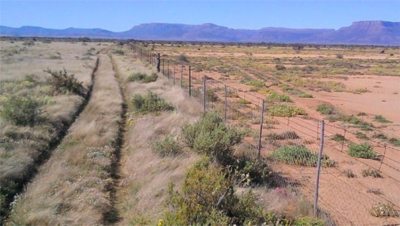
Savory regenerative farm on the left. Neighboring continuously grazed farm on the right.
The idea behind regenerative grazing is to imitate the wild herds of grazing species that crowded together for predator protection. When Ted Turner reintroduced bison to his large farm, they brought the prairie back to life in desert-like lands. Bison and grasslands have an age-old mutual relationship. Allen Savory has done something similar in the African savanna using cattle as a substitute for wild herds. Land becoming desert is now lush with tropical grasses and elephants, lions, and other wild species. Dried water courses run once again on the Turner Ranch and the Savory project in Zimbabwe.
Though counterintuitive, higher animal density improves ecosystems through herd impact. Today, movable electric fencing — polywire on reels and step-in posts — keeps herds bunched and allows precise paddock sizing. Managers adjust group density and movement frequency as forage changes seasonally. In summer, excess forage can be stockpiled for winter, making the system highly adaptive.
Mowing or Grazing
There are different strategies to utilize forage, depending on the farmer’s goal. Typically, cattle graze a third, trample a third, and leave a third for regrowth. Keeping animals from grazing all the way to the ground minimizes parasites and sickness, and maximizes forage recovery. Some might see the trampled forage as a waste, but it is key for soil fertility. It becomes earthworm and soil microbe food.
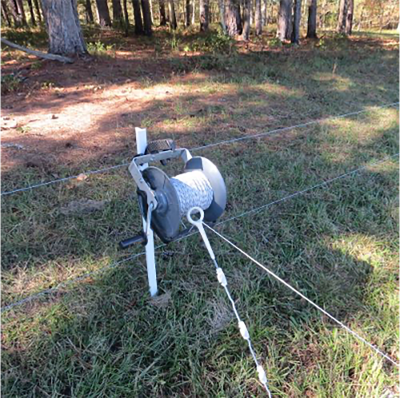
Polywire and reel. Rolling it up before the move.
Mobbing the herd concentrates the manure and urine load, also improving fertility. However, grazing management depends on the goal. The day I visited, some of the steers were being finished, soon to go to the processor. They were given a large paddock and allowed to eat the nutrition-rich growing tips before their daily move. This left a good deal of forage stockpiled to graze in winter. Some producers use a total graze with longer rest periods, thinking that management scheme promotes more plant diversity. It is as much an art as science to manage the herds, the forage, and balance animal and pasture performance.
Moving animals daily (or more often) gets them off their own manure and on to fresh forage. It will be two to three months before they come back to the same area. Once animals become accustomed to moving, they are eager to access fresh forage in the next paddock and don’t require prodding or driving them to move. The challenge comes in fencing new paddocks every day and making sure water is provided in each paddock. A free-choice mineral feeder moves with the animals from paddock to paddock.
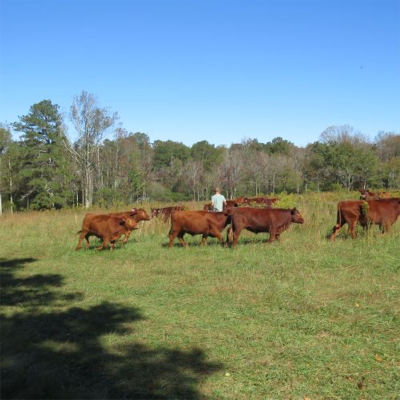
Brent moving cattle to a new paddock.
The beauty of the free-choice mineral feeder is that animals can select the minerals they need. Additionally, the cattle and sheep help re-mineralize the soil’s missing nutrients in their manure and urine over time.
Selecting the right breed is critical for animal performance on pasture, especially when finishing on pasture. Smaller framed animals tend to do better. South Poll cattle were developed by Teddy Gentry on Lookout Mountain. He crossed four breeds and selected for the cattle that were heat tolerant, long lived, docile, good mothers, and grass adapted.
South Poll cattle are now common across the country on regenerative farms. Katahdin hair sheep don’t produce wool. They shed hair. As a result, their meat isn’t loaded with lanolin, and therefore tastes better. Sheep graze differently from cattle and require guardian dogs to protect them from predators. Sheep like to browse woody and broadleaf plants, but also eat grass.
Sheep and cattle don’t share parasites, so they can be grazed one after another, or together as a “flerd” (flock and herd) depending on the goals for pasture management and meat production. Add in chickens, and you’ve got a multi-species grazing rotation.
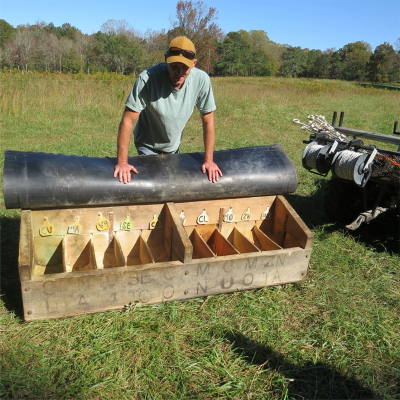
Brent shows the free choice mineral feeder pulled by his ATV.
Windy Hill allows campers to raise their chicks during summer, something the kids enjoy plus it helps out on the farm. Each year, they select different laying breeds in order to keep track of the age of the birds. This wooded chicken pasture (silvopasture) was once a privet (Ligustrum species) thicket. They brought in a forestry mulcher and ground the privet into wood chips. In the winter, they used one of the most powerful regenerative tools — bale grazing. Not in a bale ring, but rolled out across the pasture. Cows line up along the unrolled hay eating most of it, but also trampling some into the soil — all as they deposit urine and manure in the area.
Here again, many might object and say that practice is a waste of hay, but in reality it accomplishes many things, from planting the seed from the hay to fertilizing the soil. It also demonstrates the advantage of multi species farms like Windy Hill.
In a recent study of several Southeastern (including a couple on Lookout Mountain), conventionally (continuously) grazed farms were compared with farms using the regenerative principles of mobbing, mowing, and moving. A team of scientists made many measurements. The findings are remarkable. The regenerative farms absorbed four times more carbon dioxide. They recorded 442 birds of 9 species compared to the conventional farms with 152 birds of 6 species. Regenerative farms had 33% more insect diversity and 25% more soil microbes. Regenerative farms could absorb 3.5 inches of rain/hour, but the conventional farms could only absorb 1.5 inches/hour. That’s 2.3 times more absorption, a 54,000-gallon difference. After seeing the data, 80% of the conventional farms began to use regenerative practices. We are what we eat. The same is true for the animals. Having a diverse pasture with grasses, legumes, and broadleaf plants allows animals to choose what they need. As a result, their meat and eggs are more nutrient dense and healthier for us.
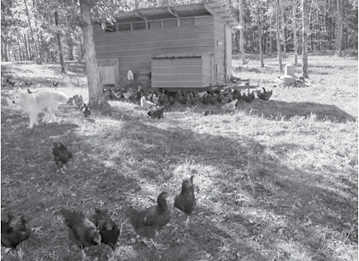
The mobile egg wagon, chickens, and guardian dog.
While confined feeding operations can be destructive, regenerative grazing can restore ecosystems while improving soil fertility. As Brent says, “It’s not the cow, it’s the how.”
Additional Resources
• Seeing is believing. You can visit many regenerative operations on YouTube.
• “Soil Carbon Cowboys” is a series of short documentaries taking you around the country to visit several regenerative operations.
• Allan Williams Boston Ted talk “First, Heal the Soil” covers the SE comparative study
• Allan Savory’s Ted talk “How To Green the World’s Deserts and Reverse Climate Change,” or
• “Running Out of Time,” his documentary on holistic (or regenerative) management describes his restoration of tropical savannas.
• Greg Judy Regenerative Rancher channel posts videos every day sharing his knowledge.
• Farm Like A Lunatic with Joel Salatin is also an excellent channel. He is an innovative farmer who shares his production practices.
Mentone Fall Festival Returns Saturday, Oct. 17
Lots of Good Food Choices and Opportunities to Sponsor Mentone is preparing to welcome thousands of visitors as the Mentone Fall Festival returns Saturday, Oct. 17, for a full day of art, music, food, and » Read More
High Temps? No Problem. Try These Cool Recipes
We’ve been spoiled most of the summer with rainy days, cloud cover, and highs in the 70s and low 80s. But today when I walked outside, I realized that luck might have run out. Corn » Read More

Valley Head Women’s Club Awards Scholarships
The Valley Head Area Women’s Club awarded two scholarships to the Valley Head High School Class of 2026. This year, the scholarships were increased in memory of JoAnn Phillips to a total value of $800 » Read More

A Bit of Our Town’s History
I decided to give you all a brief history lesson on our beautiful town this month. I even discovered a new fact or two myself. Valley Head was officially incorporated in 1922 and continues to » Read More