

Hitting the Wildflower Trail

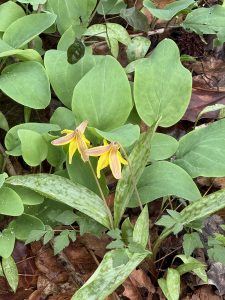
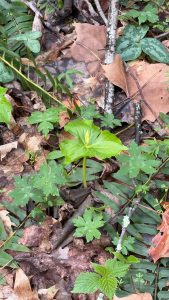 Last month, members of the Rhododendron Garden Club (RGC) and guests carpooled to the Shirley Miller Wildflower Trail (a.k.a. “The Pocket”). After heavy rains, the road into the park can be an adventure, but the trekkers prevailed. They were rewarded with views of showy spring ephemerals, as trout lilies and trillium popped through layers of wet leaves. Snacks also seemed well appreciated. Next, the redbuds along Tutwiler and Highway 117 gave an amazing display of magenta. The bright greens of nearby deciduous trees were ethereal. Northeast Alabama shines in spring beauty.
The Pocket’s trout lilies offer delicate, nodding yellow flowers with petals and sepals bent back to expose the bronze undertones. The maroon markings on the leaf also lend themselves to its Greek-inspired Latin name, Erythronium americanum. The genus name is from the Greek erythros, meaning red; americanum declares the trout lily a native species. The leaf’s resemblance to the brook trout inspired its common name, and sure enough, there are similarities between the leaves and the fish. Leaves occur in pairs. A single, unmottled leaf indicates the plant is young and not yet ready to flower; a pair of mottled leaves indicates a mature, flowering plant. They thrive in colonies in forest understories and can have a lifespan of more than 150 years.
Trout lilies have a symbiotic relationship with ants. Myrmecochory is the dispersal of seeds by ants—say that word fast three times! A nutritious, fatty coating on the seed, called an elaiosome, attracts the ants. Seeds are carried back to their nests and eaten. This aids in germination and new colony formation. Ants may be the James Brown of the insect world.
Plant trout lilies in the fall, 4 inches deep and 4 inches apart, in a partly shady woodland setting. They prefer acidic soil—damp in spring but not completely dried out in summer. They do well under trees and shrubs and will pop up before hostas, ferns, or other shade-loving plants.
The redbud tree blooms before its heart-shaped leaves appear. Cercis canadensis is in the pea family, and upon closer look, the seed pods resemble bean or pea pods. The flowers are edible, and some people even use them to make jelly. The bark of the tree has been used as a treatment for whooping cough.
The redbud is a North American native and does grow sparingly in the wild in Canada, so the species name is justified. But why “redbud” when the flowers are obviously not red? Evidently, the unopened buds appear as a deep reddish-purple color. When the leaves first sprout, they are reddish before turning green. It’s the bud that’s red, not the flower. Redbuds can be planted in either fall or spring. They are an understory tree, so plant them along the edge where they can get morning sun and afternoon shade in well-drained, slightly acidic soil. Don’t plant too deeply. Since they are such early bloomers, they serve as an excellent nectar source for early-season insects. If planted in full sun, they will “lollipop” out. Mature height is 20 to 30 feet.
Trillium grandiflorum: the genus name comes from the Latin trillix, meaning three; the species name grandiflorum means “large-flowered.” Trilliums have three petals, three sepals, and three leaves—a trifecta of perfection that is unmistakable among native plants, and the flower is indeed quite grand.
These spring ephemerals can live for decades and are slow to mature, taking four to seven years for a seed to grow into a flowering plant. They also use ant dispersal (myrmecochory). DON’T PICK the flower—it prevents the plant from producing food for the following year. Trilliums are an indication of a healthy ecosystem. Their rhizomes run deep, so deer are deterred from digging them up in winter. With more than 38 species in North America, options in color, form (trailing or upright), scent (pleasant or not), and size are numerous. The toadshade trillium emits a faint, unpleasant odor that attracts its main pollinators—flies and beetles. The “Sweet Betsy” variety lives up to its name, wafting a pleasant fragrance.
To grow trilliums, plant rhizomes 2 to 4 inches deep and 12 to 24 inches apart in moist, humus-rich, well-drained soil. They thrive in partial shade with dappled light and plenty of leaf mulch. Be patient with growth.
Next month, the RGC will meet at the MERF House on April 14 at 10 a.m. The program on native shrubs will be presented by horticulture expert and Master Gardener Martha Wood.
Did you know we have a Facebook page? Follow us at www.facebook.rhododendrongardenclub.com to receive gardening tips, get updates on our activities and “like” us!
Mentone Fall Festival Returns Saturday, Oct. 17
Lots of Good Food Choices and Opportunities to Sponsor Mentone is preparing to welcome thousands of visitors as the Mentone Fall Festival returns Saturday, Oct. 17, for a full day of art, music, food, and » Read More

High Temps? No Problem. Try These Cool Recipes
We’ve been spoiled most of the summer with rainy days, cloud cover, and highs in the 70s and low 80s. But today when I walked outside, I realized that luck might have run out. Corn » Read More

Valley Head Women’s Club Awards Scholarships
The Valley Head Area Women’s Club awarded two scholarships to the Valley Head High School Class of 2026. This year, the scholarships were increased in memory of JoAnn Phillips to a total value of $800 » Read More

A Bit of Our Town’s History
I decided to give you all a brief history lesson on our beautiful town this month. I even discovered a new fact or two myself. Valley Head was officially incorporated in 1922 and continues to » Read More