

Gopher Tortoises, Box Turtles, and Singing Plants

 This month’s article for the club would not come together. The monkey brain that is my mind was in full blown shenanigans. Should the topic be gopher tortoises, which was the subject of a conservation report not given because RGC members toured Lookout Lavender Farm last month? Or perhaps discuss box turtles. Why do box turtles cross the road? Maybe share the news that plants can sing? Such a dilemma, but the answer is … all three!
Recently in Daphne, Alabama, at a 68 Ventures construction site, gopher tortoise (Gopherus polyphemus) burrows were discovered. The company erected a 25-foot buffer zone to protect the reptiles and contacted the Wildlife and Freshwater Fisheries. Tortoises occupied six of the seven burrows. Equipment was used to carefully dig through 8-foot-deep burrows so the tortoises could be safely evacuated. None was injured. After being measured and weighed, the tortoises found new homes in a protected, sandy soil, longleaf pine forest. Gopher tortoises have a strong homing instinct, so 68 Ventures provided funding for a silt fence to be buried several feet into the ground, preventing the tortoises from tunneling out. After about a year, the tortoises consider the new site home and the fence can be removed.
Gopher tortoises, the only native tortoise east of the Mississippi, are considered a keystone species, with over 300 other species using their burrows. Rare or endangered species, like gopher frogs, Eastern indigo snakes, and striped newts, can hunker down to escape heat or wildfires. Gopher tortoises can live 90 years. Cooperation between private landowners, conservation groups, and responsible businesses will ensure that gopher tortoises and other species thrive in Alabama for future generations.
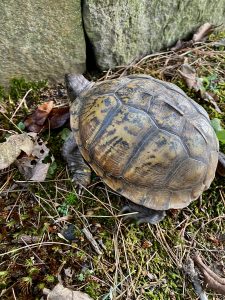
Unlike its distant cousin, the box turtle (Terrapene) is not endangered unless it gets caught in the middle of the road and a driver is not paying attention. In June or July, the female starts venturing to find a nesting site, so move her off the road, but don’t take her home. Those toenails are sharp, so be careful when lifting. Around age 12, females start laying hutches of three to six eggs in a sunny, sandy, or loamy spot and will continue until her 80s! Take care when mowing, as yards are prime nesting sites. Depending on soil moisture and the temperature, eggs can take from 50 to 90 days to hatch. About the size of a quarter, hatchlings need protein and moisture to survive. Box turtles are known to eat poisonous mushrooms, so predators beware.
Like the gopher tortoise, box turtles have strong homing instincts and a limited range of territory, usually less than 2 acres. They live for decades, some over a century! The hinged lower shell (plastron) allows the head and appendages to tuck in and then close like a box to protect the turtle from predators. The gopher tortoise does not have that capability. Male turtles have a brighter orange neck color and red eyes to attract that special female. The male plastron (under shell) is rounded, and the top shell is flatter than that of the brown-eyed female.
What do you call a walking vegetarian turtle that isn’t fond of water? A tortoise. All tortoises are turtles but not all turtles are tortoises. Tortoises live exclusively on land from deserts to tropical forests. Turtles can live in the sea. Tortoises generally have a vegetarian diet, while turtles are omnivorous. It’s like all azaleas are rhododendrons but not all rhododendrons are azaleas. So confusing.
Now On to Singing Plants
Last, singing plants. No, they don’t really sing but they do give off ultrasonic popping or clicking sounds that can be transposed into music. Plant biosonification uses devices to “listen” to plants by translating their bioelectric changes into sound data. Started in the 70s at a spiritual community in Italy, using modified polygraph machines, the early devices converted plant voltage resistance into musical melodies. Today, devices are reasonably priced, so anyone can go into nature and listen to plants. Pseudoscience? Perhaps, but listening to clover, roses, olive trees, or mullein “sing” on YouTube is hauntingly beautiful and totally relaxing. If a person can see glory in flora, why not hear it as well?
Next month, our guest speaker is Helen Allen, who will share her knowledge of rainwater collection. Date is July 14 and time is 10 a.m. at the MERF House. While there, walk down to see the newly completed boardwalk and arbor at the Moon Lake Garden.
Did you know we have a Facebook page? Follow us at www.facebook.rhododendrongardenclub.com to receive gardening tips, get updates on our activities and “like” us!
Mentone Fall Festival Returns Saturday, Oct. 17
Lots of Good Food Choices and Opportunities to Sponsor Mentone is preparing to welcome thousands of visitors as the Mentone Fall Festival returns Saturday, Oct. 17, for a full day of art, music, food, and » Read More

High Temps? No Problem. Try These Cool Recipes
We’ve been spoiled most of the summer with rainy days, cloud cover, and highs in the 70s and low 80s. But today when I walked outside, I realized that luck might have run out. Corn » Read More

Valley Head Women’s Club Awards Scholarships
The Valley Head Area Women’s Club awarded two scholarships to the Valley Head High School Class of 2026. This year, the scholarships were increased in memory of JoAnn Phillips to a total value of $800 » Read More
A Bit of Our Town’s History
I decided to give you all a brief history lesson on our beautiful town this month. I even discovered a new fact or two myself. Valley Head was officially incorporated in 1922 and continues to » Read More