

Rhododendron Garden Club News – July 2024

At the June meeting of the Rhododendron Garden Club (RGC), 14 members welcomed Beth Milam Sewell from the environmental education program at Little River Canyon to teach the group about all things black bear. Beth brought show-and-tell items, cleared up some common misconceptions, and shared findings about the bears in Northeast Alabama.
A Google search indicated that a group of bears can be called a “sloth” because they tend to be shy and solitary. However, “sleuth” is the preferred nomenclature. In Middle English, the word sleuth meant “the track or trail left by an animal or person.” Anyone who has traveled County Road 89 or Highway 117 on trash day cannot miss the garbage trail of the opportunistic eaters. With a nasal cavity structured like a honeycomb and the olfactory bulb five times the size of that of humans, a sleuth can pick up aromas a mile away. A friend says she puts ammonia around her garbage and has had no break-ins so far.
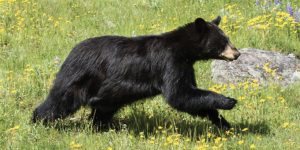
BearWise.org has excellent info about black bears and directions for modifying trash cans and dumpsters. Trash is an easy meal for a bear, but purple scat shows grubs and berries are staples in the diet. Unexpectedly, bears are delicate eaters, using their lips to gently pull berries off branches.
For years, black bears roamed Alabama, and then humans destroyed their habitats and hunted them to extirpation. Gone for 100-plus years, now they’ve returned. In 2012, Auburn set hair traps and estimated 30 bears were Alabamians, and they were great-grandparents of the current population of over 100 bears.
No, bears were not brought in from other areas and dropped by helicopter into the Little River Canyon. Although bear claws are long and adapted for climbing, the canyon is deep, it floods, and the bears prefer flatter ground with heavily wooded areas for sleeping, climbing, and eating.
Using a safe corridor into Alabama, bears from Georgia are now found in DeKalb, Etowah, and Cherokee counties. Genetically, our sleuth, Ursus americanus americanus, is a subspecies of the American black bear and is considered petite compared to other black bear populations. Our ladies weigh around 130 pounds, and males average 250 (no, you are not seeing a 500-pound male in your trash can). Most of that bulk is taken up with a soft underfur with coarse guard hairs.
Beth was fortunate to be able to shadow biologist Hannah Leeper while doing research on the Northeast Alabama bears. Sadly, Hannah’s grant ended, and she moved on. This past spring she returned to remove tracking collars that were reaching the end of their two-year battery life. The much-too-large collars had to be altered to fit by drilling holes and adding foam and duct tape, which negated their warranty. Beth described how they trapped, sedated, weighed, and tested the ladies, then collared and ear tagged them before releasing them. Tracking only the female population, Hannah learned about home ranges, mates, cub survival rate, and diet. We hope the data Hannah collected will be published soon and have lots of photos.
The bears in our area do not live in caves or go into true hibernation, since our winters are mild. Mom lives in brush piles or tree falls in the woods. If she has had a bad season and is undernourished, her body will not produce cubs. Fortunately, our area has abundant resources; our bear cubs have a survival rate of 99%, with more cubs born per litter than the national average. We are seeing three and four cub births, so moms are doing well. At birth, cubs are the size of a hand and have eyes and ears closed. When the cubs are Lab puppy size, mom teaches them to climb trees and search for food. Their back feet are backward, with the toes pointed out, so it’s easier to climb trees. Male cubs are booted out on their own at one year, but female cubs stay longer. With a national range for females of 50 miles, our petite ladies only range 6 miles. With typical Southern hospitality, relative females will share and overlap ranges.
They move at dusk and dawn and spook easily. If you see a bear, don’t run or curl up in a ball. They can run 30 miles an hour but not for long. Back away slowly. Do not shoot them. It is illegal to kill the black bear in Alabama, and hefty fines or perhaps jail time may result. A black bear would rather run from you than toward you. If startled, it may stand and vocalize. Avoid direct eye contact. Make yourself look bigger, make noise, and wave your arms. With sensitive noses and ears that are shaped to capture sound and located on top of the head, bears usually smell and hear you before you see them. Make sure the bear has a free direction to escape. Never purposely feed a bear. Bring in bird feeders at night and put out trash the day of pickup. There have been no reports of bears attacking domestic animals in the area.
Who puts out big food containers with tempting odors? Not the bears. It is our job to discourage their hunt for easy dining and to advocate for them. After all, humans are the mammals with higher intelligence.
At our next meeting, Tuesday, July 9, Lula Lake Land Trust representatives will present the Plight of the Hemlocks. Come at 10 a.m. at Moon Lake Library for interesting information, comestibles, and conviviality.
Join Us!
The RGC meets at 10 a.m. each month on the second Tuesday. For information, email rhododendrongardenclub@gmail.com and find the group on Facebook.
RGC is a member of the National Garden Club; Deep South, Inc.; Garden Club of Alabama; District ll and NE AL Federation of Garden Clubs.
Mentone Fall Festival Returns Saturday, Oct. 17
Lots of Good Food Choices and Opportunities to Sponsor Mentone is preparing to welcome thousands of visitors as the Mentone Fall Festival returns Saturday, Oct. 17, for a full day of art, music, food, and » Read More

High Temps? No Problem. Try These Cool Recipes
We’ve been spoiled most of the summer with rainy days, cloud cover, and highs in the 70s and low 80s. But today when I walked outside, I realized that luck might have run out. Corn » Read More

Valley Head Women’s Club Awards Scholarships
The Valley Head Area Women’s Club awarded two scholarships to the Valley Head High School Class of 2026. This year, the scholarships were increased in memory of JoAnn Phillips to a total value of $800 » Read More

A Bit of Our Town’s History
I decided to give you all a brief history lesson on our beautiful town this month. I even discovered a new fact or two myself. Valley Head was officially incorporated in 1922 and continues to » Read More