

Lula Lake Land Trust – Saving Native Hemlocks

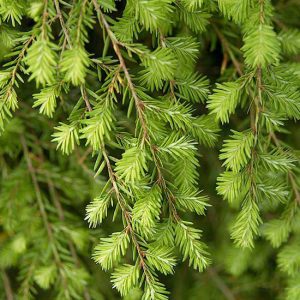
Socrates died from drinking poisonous hemlock. However, the hemlock given to Socrates was the deadly Conium maculatum, indigenous to the Mediterranean, not from the native Eastern Hemlock (Tsuga canadensis) or Carolina Hemlock (Tsuga carolinus). Same common name, but one genus is a killer and the other is the victim of the invasive Hemlock Wooly Adelgid (HWA, Adelges tsugae). Stately Hemlocks have become silver ghost trees in the Blue Ridge Mountains, with 80% of the native population gone.
 In June, the Rhododendron Garden Club hosted Cody Roney and Patrick Kelly from the Lula Lake Land Trust. Thanks to the foresight of Robert M. Davenport Sr., the Lula Lake Land Trust (LLLT) was established in 1994 from his land buys.
Their website explains:
“From this solid foundation, LLLT began working to protect the properties now known as The Cloudland Connector, Five Points, and Moonshine Trail systems. These acquisitions, and others, have increased LLLT’s land holdings from the original 750-acre Core Preserve to over 4,000 acres, adding 3,000 acres to Cloudland Canyon State Park and 2,000 acres in Johnson’s Crook on Lookout Mountain.”
With conservation a priority, limited access and low-impact recreational activities are offered. The hemlock forest along Rock Creek is critical to the ecosystem. A foundation species, the roots stabilize the stream banks and cool and filter the water that is vital for brook trout survival. The trees provide shelter for wildlife, nesting sites for warblers, nourishment for white-tailed deer that forage on the foliage, and the seeds from the tiny cones feed smaller critters (nature.org).
A Japanese import first reported in Virginia in the 1950s, the aphid-like HWA was first noted in Georgia in 2002 and discovered on LLLT property in 2013. First-generation eggs laid in the spring number around 175. A second, fall generation numbers 300. The eggs are found on the underside of branches in a waxy, white “wool” sac. The adelgid feeds on the sap at the base of the needles, disrupting nutrient flow, with death to the tree occurring in three to five years.
LLLT had to determine best practice (cost, time, efficiency) and consider the ethics of chemical treatments. Working with a private contractor in 2014, application of Imidacloprid directly into the soil using hand-powered soil injection reduced run-off into the creek.
Taking about a year, the insecticide is absorbed by the tree root, moves through the cambium layer to eventually reach the needles. Treatments last five to seven years. The trees were treated in phases, targeting those in the 20-foot range having diameters of less than 7 inches.
A natural predator beetle (St, Sasajiscymnus tsugae) has been imported from Japan to feed on the HWA. The beetle’s life cycle parallels the HWA, and with the adelgid its only food source, repetition of the Godzilla kudzu disaster is unlikely. LLLT has set aside several 5- to 7-acre sites for the St beetle release. The hope is that the biocontrol method will eventually replace the need for chemicals.
Socrates stated, “If I can assign names as well as pictures to objects, the right assignment of them we may call truth, and the wrong assignment of them falsehood.”
The LLLT is the right assignment for responsible stewardship and conservation. For information on our neighbor to the north, visit lulalake.org.
For more information, check out Wild Alabama. One of their projects is to locate Alabama’s hemlocks and monitor their health. You can download the iNaturalist app, take a photo of a hemlock in Alabama, and upload it to the app. The tree’s location will be added to their map. iNaturalist is useful when you’re outdoors and wish to identify other plants, bugs, and animals. If you don’t have service on the trail, you can snap a picture to upload later. There is also a web version of this tool: https://www.inaturalist.org/projects/save-the-alabama-hemlocks
After reading last month’s “Groundhog” article about this month’s meeting, Will Lance reached out to us about donating St beetles for release in Mentone. He attended our meeting this month but refused reimbursement for his purchase from Tree Savers.
Thank you, Will, for your passion and encouragement for folks to take action. One person, one tree. Thanks to our librarian, Anne McLeod, for agreeing to receive the package.
The August 13 meeting is always about preparations for the upcoming Federation Flower Show at the VFW Fairgrounds. This year’s show, Fall Around Alabama, will be judged on October 14. Meetings are held in the library and start at 10 a.m.
Join Us!
The RGC meets at 10 a.m. each month on the second Tuesday. For information, email rhododendrongardenclub@gmail.com and find the group on Facebook.
RGC is a member of the National Garden Club; Deep South, Inc.; Garden Club of Alabama; District ll and NE AL Federation of Garden Clubs.
Mentone Fall Festival Returns Saturday, Oct. 17
Lots of Good Food Choices and Opportunities to Sponsor Mentone is preparing to welcome thousands of visitors as the Mentone Fall Festival returns Saturday, Oct. 17, for a full day of art, music, food, and » Read More

High Temps? No Problem. Try These Cool Recipes
We’ve been spoiled most of the summer with rainy days, cloud cover, and highs in the 70s and low 80s. But today when I walked outside, I realized that luck might have run out. Corn » Read More

Valley Head Women’s Club Awards Scholarships
The Valley Head Area Women’s Club awarded two scholarships to the Valley Head High School Class of 2026. This year, the scholarships were increased in memory of JoAnn Phillips to a total value of $800 » Read More

A Bit of Our Town’s History
I decided to give you all a brief history lesson on our beautiful town this month. I even discovered a new fact or two myself. Valley Head was officially incorporated in 1922 and continues to » Read More