

A Century of Summers: Camp DeSoto Marks 100 Years on Lookout Mountain

“I wanna go back, I wanna go back to Camp DeSoto! I wanna go back to the camp I love…”
For generations, this familiar refrain has echoed across the grounds of Camp DeSoto, as campers young and old have added verses celebrating their home away from home on Lookout Mountain. This summer, the words carried special meaning: hundreds of women did go back — to celebrate the camp’s 100th summer.
On July 26 and 27, 445 alumnae from across the country gathered in Mentone for a weekend of remembrance, laughter, and song. Spanning seven decades in age — from 16 to 86 — participants greeted one another with squeals of delight and hugs that bridged the years since their last summer together.
For some, the reunion was their first time back since the day they packed up their trunks and said goodbye as campers. Many described the familiar rush of emotion that comes the moment they begin the drive up the mountain to Mentone, a place that has long been a source of comfort and connection. Once inside the camp gates, the celebration was a simple but joyful 24-hour immersion in DeSoto traditions.
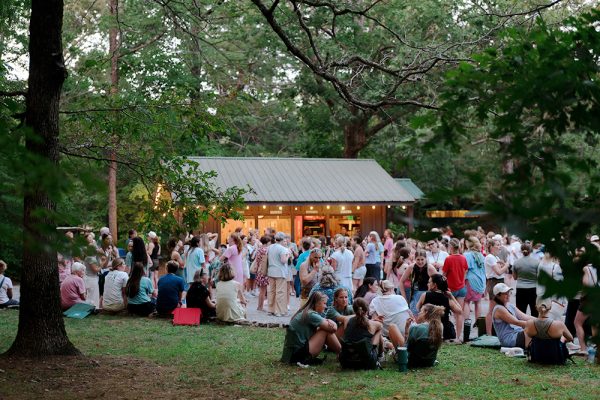
More than 400 women gathered in July to celebrate Camp DeSoto’s 100th year.
Saturday evening brought line dancing to camp classics like “Elvira,” “Let’s Hear It for the Boy,” and “Rockin’ Robin,” followed by a picnic on the Playfield, featuring grass-fed beef burgers from The Farm at Windy Hill, a partner enterprise of the camp. Ice cream sandwiches — a post-picnic staple — were enjoyed before everyone gathered in the beloved central pavilion, “The Gym,” for 100 Years of DeSoto Stories and Songs.
Seated on familiar wooden benches, alumnae honored the camp’s directors through the decades from founder Curtis Springer, who originally established DeSoto as a boys’ camp and Eloise Temple, who transitioned it into a girls’ camp (and later established Skyline Ranch Camp for Girls), to beloved leaders Bess Heron and Norma Bradshaw, and later Sue Henry, who emphasized Christian growth and intentional living. The Hurt family continues to uphold the camp’s mission today. Sarah Hurt is the current director, and her parents, Phil and Marsha Hurt, remain involved as owners and executive directors.
The evening program featured a stage backdrop created by Oxford, Mississippi, artist Carlyle Wolfe Lee (camper ’92–’94, staff ’97–’01, ’04), incorporating a hand-drawn map of the camp layered with botanical designs. Folk musician Caroline Herring of Decatur, Georgia (camper ’81-’84, staff ’87,’91-’93), closed the program with her songs “Wise Woman” and “I Went for a Month,” which reflect both her daughter’s and her own experiences at DeSoto. The night ended in a friendship circle, arms crossed, hands joined, singing “Taps.”
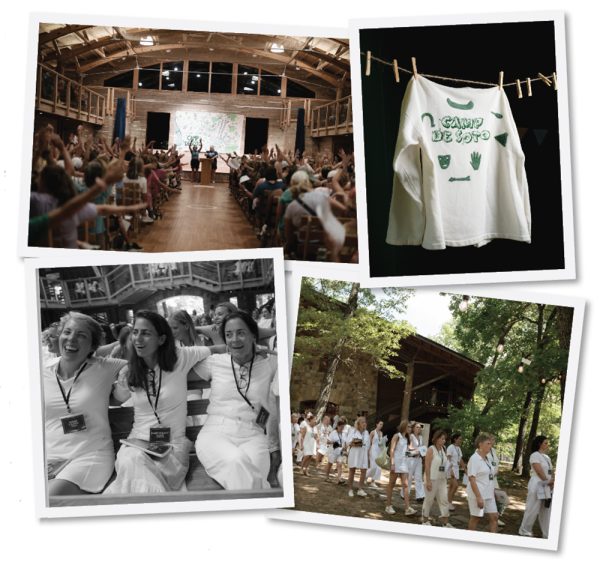
Camp DeSoto has made an unforgettable impact on the lives of thousands of young women across its rich history. More than 400 of them gathered in July to celebrate the camp’s legacy and its 100-year anniversary.
Sunday morning began as every camp day does, with Morning Watch, an all-camp devotional at the lakeside Worship Rocks. After a traditional breakfast of blueberry muffins and grits, attendees donned the customary all-white attire for the Sunday worship service in the gym, a long-standing tradition that instantly transported alumnae back to their camper days.
Many young girls have discovered and deepened their experience of God’s love during their summers at Camp DeSoto. Sunday worship was especially poignant as generations of women collectively thanked God for the protection and faithful love they feel at camp, the spiritual growth campers are invited into by DeSoto counselors, and the ways Christ is evident in the natural beauty of the mountain. Anna Russell Thornton of Nashville (camper ’08–’10, staff ’13–’19) preached from Luke 18:1–8; music was arranged by Millie Livingston of Birmingham; the choir was organized by Susan Petty Needler of St. Louis; flowers were provided by The Farm at Windy Hill and Creekside Flower Farm and were arranged by Susan Thompson Tyner of Fort Worth, Texas (staff ’12-’23). More than 400 women processed into the gym two-by-two, as generations of campers have done before them.
No Sunday at DeSoto would be complete without a fried chicken dinner, pear salad, and vanilla ice cream with peanut butter and honey. This meal was prepared and offered by DeSoto’s dedicated team of cooks and servers, led by Head Chef Margot Messer of Valley Head. While the entire group did not fit into the dining hall, they picnicked together, closing with traditional songs including “The Birds in the Treetops” and the six-part harmony of “Jubilate Deo.”
After just 24 hours, goodbyes came too soon. While a summer at Camp DeSoto could never be captured in such a brief celebration, many “DeSoto girls” did feel they got to go back to camp again. As one attendee reflected, “Though we find ourselves changed, the essence of this place and all that we love about it remains the same.”
Much of the camp’s history is preserved in Camp DeSoto: A History by Norma Bradshaw Flora and Norma Flora Cox, daughter and granddaughter of beloved director Norma Caldwell Bradshaw, affectionately known as “Brad.” The book is available at the Moon Lake Library and at campdesotostore.com.
One hundred summers have passed on Lookout Mountain, but for those who have sung the songs, walked the trails, and worshipped in the gym, the spirit of Camp DeSoto remains as vibrant as ever.
Mentone Fall Festival Returns Saturday, Oct. 17
Lots of Good Food Choices and Opportunities to Sponsor Mentone is preparing to welcome thousands of visitors as the Mentone Fall Festival returns Saturday, Oct. 17, for a full day of art, music, food, and » Read More

High Temps? No Problem. Try These Cool Recipes
We’ve been spoiled most of the summer with rainy days, cloud cover, and highs in the 70s and low 80s. But today when I walked outside, I realized that luck might have run out. Corn » Read More

Valley Head Women’s Club Awards Scholarships
The Valley Head Area Women’s Club awarded two scholarships to the Valley Head High School Class of 2026. This year, the scholarships were increased in memory of JoAnn Phillips to a total value of $800 » Read More

A Bit of Our Town’s History
I decided to give you all a brief history lesson on our beautiful town this month. I even discovered a new fact or two myself. Valley Head was officially incorporated in 1922 and continues to » Read More