

Agritourism: Our Trip to White Oak Pastures
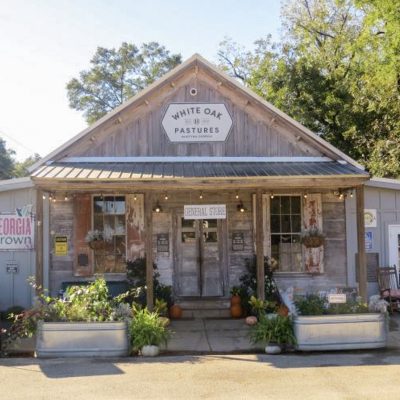
White Oak Pastures
Last fall, Nancy and I packed up and headed south on Highway 27 for about five hours to White Oak Pastures in the small town of Bluffton, Georgia. We first learned of Will Harris and his farm a few years ago through his appearance in the video “100,000 Beating Hearts” on the YouTube series Soil Carbon Cowboys. White Oak Pastures is a large (3200+ acre), diverse, and vertically integrated regenerative farm. They additionally contract graze sheep on another 2,000 acres under solar panels. The animals live on the farm from birth to processing, and are directly sold to customers, restaurants, and stores nationwide.
Will is the fourth generation of his family to operate this farm. He began as a conventional farmer, but after he loaded a group of feeder calves in a three-layered semitrailer to send to the Midwest, he started to think about what kind of life those calves would have after he had been so careful to ensure they had a good start to life. He began to alter his farm at that point. The farm has three goals: first, to provide a humane and healthy life for his animals; second, to use animals to improve his soils and the ecosystem; and third, to have a positive effect on his community. White Oak Pastures is the largest employer in the county and has brought the small town of Bluffton back from the ashes that so many other small Southern towns experience.
Agritourism wasn’t a goal, but so many people from around the country and world wanted to visit that they began building cabins around the farm, buying homes in Bluffton as they became available, and building an RV campground for visitors. They offer a variety of tours, horseback rides, and workshops. They allow you to visit any part of the farm and its many operations on your own, with the request that you shut any gate you open.
We live in the woods near Menlo, so for a change, we opted to stay in one of the townhouses, a short stroll from the farm store and restaurant that is in the heart of Bluffton. In the store, you can buy a variety of grass-raised and finished beef, pastured pork, rabbit, lamb, and mutton cuts, as well as vegetables, fruits, honey, leather goods, tallow, and lard products from hand creams to soap, all produced on the farm. There is also a restaurant that provides three meals daily, serving food from the farm. The farm has two meat processing plants (abattoirs). Any waste in the process is composted and returned to the soil after decomposition.
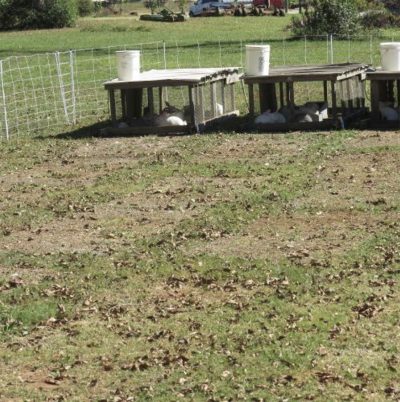
Notice the grazed areas as the hutches are moved from day to day.
The farm is subdivided into over a hundred paddocks, and most of the animals are moved daily. Herd size is large, with a couple of thousand head of cattle and hundreds of pigs being managed from paddock to paddock. When new land is acquired, they begin rolling out hay and densely stocking cattle to concentrate organic matter and spread manure and urine to start improving fertility and healing the soil.
Rabbits were grazed behind the house where we were staying. The hutches have wire bottoms to prevent digging but allow grazing. They were moved daily. The electric netting around the hutches protects from predators (mainly neighborhood dogs). Rabbit is one of the more popular products, and the store was out during our stay.
A few miles south of the farm, sheep are contract grazed under 2,000 acres of solar panels. They are also moved daily with the help of herding dogs. They not only provide meat to sell, but they also earn a fee from the solar company for weed and grass maintenance. It was interesting to see a regenerative operation of this scale. The multiple species are used synergistically to enhance soil fertility, water retention, and pasture/ecosystem restoration. Most of the surrounding area is row-cropped, primarily with peanuts, and the soils are open to erosion.
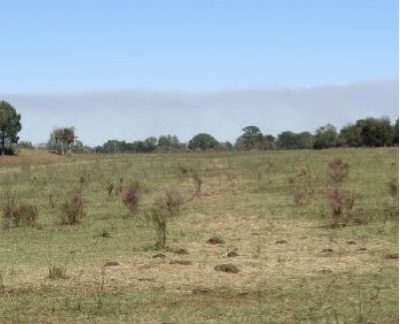
Rolled out hay and the resulting manure load
During rain events, the runoff from White Oak Pastures isn’t muddy, but it is from the neighboring row-cropped farms. There are two other interesting tourist stops in the area. The first, the Kolomoki Mounds, are only five miles or so away from Bluffton. They are a reminder that this land has been farmed for well over 1,000 years. It is the oldest Woodland Indian site in the Southeast and contains Georgia’s oldest temple mound, standing 57 feet tall. The other site, closer to Columbus, Georgia, is Providence Canyon State Park, also known as Georgia’s “Little Grand Canyon.” It is easily accessible on arrival or departure from White Oak Pastures. It formed as a result of poor farming practices in the 1800s, allowing erosion so massive that gullies 150 feet deep were formed, so deep that it seems to be a canyon.
We can farm in a sustainable regenerative manner, enhancing soil fertility and ecological health, or in a way that degrades and even destroys soils. White Oak Pastures makes a small profit, supports multiple families, and enhances the local community. It serves as an example of how we can grow high-quality food as we improve the environment.
Bill Martin is a retired science teacher.
Resources:
- Visit the White Oak Pastures website.
- See all their different enterprises on their YouTube channel.
- Their nonprofit, The Center for Agricultural Resilience, offers workshops and resources.
Mentone Fall Festival Returns Saturday, Oct. 17
Lots of Good Food Choices and Opportunities to Sponsor Mentone is preparing to welcome thousands of visitors as the Mentone Fall Festival returns Saturday, Oct. 17, for a full day of art, music, food, and » Read More

High Temps? No Problem. Try These Cool Recipes
We’ve been spoiled most of the summer with rainy days, cloud cover, and highs in the 70s and low 80s. But today when I walked outside, I realized that luck might have run out. Corn » Read More

Valley Head Women’s Club Awards Scholarships
The Valley Head Area Women’s Club awarded two scholarships to the Valley Head High School Class of 2026. This year, the scholarships were increased in memory of JoAnn Phillips to a total value of $800 » Read More

A Bit of Our Town’s History
I decided to give you all a brief history lesson on our beautiful town this month. I even discovered a new fact or two myself. Valley Head was officially incorporated in 1922 and continues to » Read More