

Cover Crops for Healthy Soil, Crops, and Customers

This is the sixth in a series of articles on regenerative agriculture, featuring local residents involved in the movement.
My wife, Liz, and I own Mountain Sun Farm and grow organic fruits and vegetables in the sandy soils of Mentone. We’ve farmed organically now for 11 years as our sole household income and sell our produce nearly year-round to individuals locally and in Chattanooga.
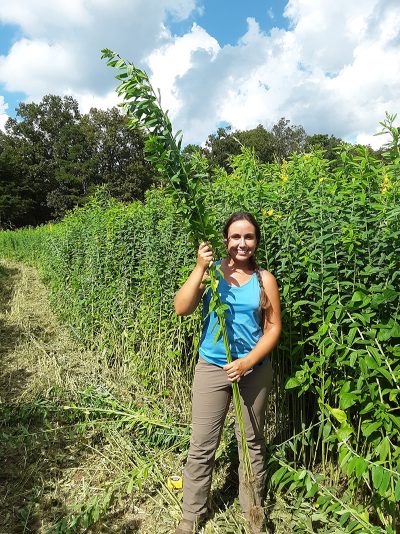
Liz Simpson at Mountain Sun Farm
When we bought our farmland here in 2017, the first thing we did was plant winter cover crops — some fields in rye and hairy vetch, and others in oats and peas. Cover crops, or “green manures,” are crops planted to improve the soil before and after “cash” crops. Instead of being harvested, they’re incorporated into the soil to feed soil microorganisms. Their benefits are lengthy, but mainly they:
- sequester carbon and nitrogen from the air
- “cover” the soil to protect from erosion
- scavenge nutrients deep in the soil
It took years for us to understand how to grow them to full maturity, yielding maximum benefits within the strict deadlines of organic vegetable production.
Zero Fertilizer
Timing, species, and seeding rate are all important. Early on, we used granular fertilizer (made from organic hen manure) in addition to our cover crops to feed our vegetable crops. In 2023, we began reducing fertilizer rates down to 50%, and this season all crops were fed solely with cover crops and zero fertilizer. But why would we do this?
Albert Howard, a pioneer advocate for organic agriculture, wrote in his 1940 book An Agricultural Testament: “The wheel of life is made up of two processes — growth and decay … Agriculture must always be balanced. If we speed up growth we must accelerate decay. ” This insight was our first inspiration to work toward relying solely on “decaying” organic matter from cover crops for fertility. It was in line with observations we’d experienced over the years — like how vegetables that followed mature cover crops seemed to always yield and resist disease especially well and how the high organic matter, or humus, in our compost piles seemed to generate miracles. The pile could grow volunteer tomato plants that survived frost, while the tomatoes in the field died. Or you’ll find volunteer squash plants that never became diseased. Finally, we realized the more fertilizer we used, the more foliar diseases occurred.
When I was a college student 15 years ago, eagerly taking every microbiology course available, the far-reaching importance of the human gut microbiome was still mostly underappreciated. We now understand that the microbes in our gut impact our mental health, immune systems, risk of cancer, and even our offspring’s health long after birth. Whether you have “healthy” or “harmful” gut microbes is directly impacted by your diet. “You are what you eat” really is true. If you eat lots of carrots and apples, you’ll feed the healthy bacteria that we’ve always relied on to digest high-fiber whole foods. Yet, if you eat ultra-processed foods like snack crackers and most white breads, you’ll outsource the microbes’ job to machines on food manufacturer assembly lines. Those foods are essentially already digested, leaving healthy gut microbes without a food source and causing their decline or extinction.
While we’ve finally begun to appreciate the role of microbes in our stomachs, the microbes in soil (the “stomach” of a plant) are still underappreciated. Even many agricultural scientists still believe that chemical fertilizers alone can carry a wholly healthy crop. I think in another 15 years, we’ll widely accept what Albert Howard was observing — that the immune system of a plant, and even the health of those who eat it, are significantly dependent on the plant’s partnership with soil microbes, which require a continual supply of organic matter to thrive; that tomatoes grown in the absence of mycorrhizal fungi do not convey the same nutrition as those grown with organic sources of fertility like compost or green manure (or mulch or wood like our neighbors who wrote previously in this series are using). While synthetic fertilizers provide nitrogen, they ignore the need for organic matter; it’s an unbalanced diet.
Currently, our favorite warm-season cover crop mix is 100lbs/acre sunn hemp, 10lbs/acre sunflower, and 1lb/acre buckwheat. We seed fields in this from May through August.
It’s ready to be mowed and incorporated in 60 days. In excellent stands, we’ve measured 6,000lbs/acre of dry biomass and >200lbs/acre of nitrogen. That is the sunn hemp’s achievement through its partnership with rhizobia bacteria that live in little nodules on its roots (all legumes fix nitrogen from the air in this way). The buckwheat provides pollen and nectar for beneficial insects, and the sunflowers are mainly there to capture any already-present soil nitrogen before rains flush it deeper than the root zone.
For cool-season covers, we rely on crimson clover, now at 30-40lbs/acre. We seed this August through November. It reaches maturity at flowering in April or May.
If you read modern publications on cover crops from the USDA or universities, you might come away thinking it’s a new method or one that may have potential but requires more research. Even my favorite book on the topic, Managing Cover Crops Profitably (free online at Sare.org), describes the use of sunn hemp as “up and coming,” yet Albert Howard described seeing it used by farmers in Sri Lanka in 1938 and green manure in general used all across the Indian subcontinent. After traveling Asia in 1909, F. H. King wrote in Farmers of Forty Centuries: “the growing of legumes in rotation with other crops very extensively for the express purpose of fertilizing the soil is one of their old, fixed practices.” Cover cropping was only recently forgotten. Before the 1950s, farmers across Alabama still relied on crimson clover, winter peas, and blue lupin to provide soil fertility, as documented in USDA bulletins like “Winter Legumes for Green Manure in the Cotton Belt” (1942). Unfortunately, when you drive through the row crop fields of North Alabama today, it is rare to see a green manure planted. But the practice is slowly being re-adopted nationally, with an explosion in interest the past five years. With luck, I think the times they are a-changin’.
BY BRIAN SIMPSON
Mentone Fall Festival Returns Saturday, Oct. 17
Lots of Good Food Choices and Opportunities to Sponsor Mentone is preparing to welcome thousands of visitors as the Mentone Fall Festival returns Saturday, Oct. 17, for a full day of art, music, food, and » Read More

High Temps? No Problem. Try These Cool Recipes
We’ve been spoiled most of the summer with rainy days, cloud cover, and highs in the 70s and low 80s. But today when I walked outside, I realized that luck might have run out. Corn » Read More

Valley Head Women’s Club Awards Scholarships
The Valley Head Area Women’s Club awarded two scholarships to the Valley Head High School Class of 2026. This year, the scholarships were increased in memory of JoAnn Phillips to a total value of $800 » Read More

A Bit of Our Town’s History
I decided to give you all a brief history lesson on our beautiful town this month. I even discovered a new fact or two myself. Valley Head was officially incorporated in 1922 and continues to » Read More