

Farming Like the Ancients: Terra Preta Could Transform Modern Agriculture

This is the third in a series of articles on regenerative agriculture, featuring local residents involved in the movement.
The ancient farming practice of terra preta is possibly the most exciting and important discovery in modern agriculture. Using lidar technology, archaeologists have uncovered how essential this organic gardening method was to native people for thousands of years. Similar systems have been employed from the Amazon to China, and throughout North America.
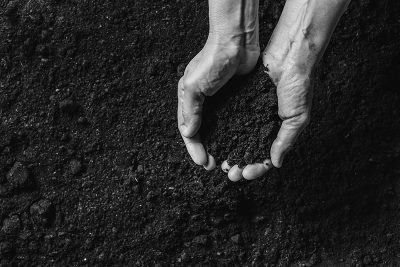 What is terra preta? Why is it so important today? Portuguese for dark soil, terra preta is not native to the Amazon region, where the yellow clay soil is acidic and nutrient poor. It is evident from its ingredients that it was originally made by people. The principal ingredient is charcoal with broken pottery, compost, manure, mulch, kitchen scraps, and nitrogen-fixing bacteria. Terra preta could be one of the most amazing and potentially EXTINCTION PREVENTING inventions of the human race. It is still fertile after centuries of neglect and it actually spreads into surrounding soil, slowly increasing in mass over time. The secret to charcoal may be the vast amount of habitat it provides for beneficial soil bacteria and fungi. The porosity of a gram of charcoal creates a surface area of more than 300 square meters!
What do these bacteria actually do? They play a critical role in the nitrogen cycle, which is essential for all life. Nitrogen is the key element in DNA, RNA, and protein. Atmospheric nitrogen gas, N2, has a triple bond between two atoms, making it so stable and unreactive that plants cannot use it.
Nitrogen-fixing bacteria, such as azotobacter, have the ability to break the triple bond of N2. These bacteria also cause hydrogen atoms to form ammonia, NH3, and ammonium, NH4. Both of these molecules are used by plants to form DNA, RNA, and protein. A further step in making nitrogen available to plants is taken when they oxidize ammonia into nitrite, NO2, and nitrate, NO3.
These essential soil bacteria need the protection of a habitat to live and thrive. Otherwise, they are at the mercy of typically hostile soil environments. Legumes, like peas, beans, and clover, form nodules on their roots to house nitrogen-fixing bacteria called Rhizobium. Legumes are used in crop rotation by regenerative farmers to keep soil fertile by attracting and protecting Rhizobium bacteria.
Adding charcoal to soil serves a similar function many times over, and it is permanent. The vast porosity of charcoal provides habitat to free living bacteria that are not protected by legume nodules. It also retains moisture, and provides aeration, essential in converting ammonia into nitrite and nitrate. Since charcoal is almost pure carbon, it does not break down like other organic matter. It can remain active in soil for centuries. Not all charcoals are the same. Some commercial briquettes contain unwanted chemicals. Making your own is the safest bet. Lumps should be crushed into tiny pieces, then mixed with compost to allow bacteria to fully inoculate the charcoal. The recommended amount of inoculated charcoal to add to soil is 5%-10%. Water quality is another issue regarding the health of beneficial soil bacteria. Chlorine, and fluoride in tap water, are obviously detrimental to bacteria and should be avoided if possible. Rain water or well water are preferable.
Contrast terra preta with slash-and-burn methods, which cut down and burn forests. These agricultural fields are at best fertile for several short years, necessitating more slash-and-burn to keep it going. Modern farming practices, which kill off crucial soil microorganisms with chemical fertilizers, herbicides, and pesticides, are also counterproductive. They perpetuate an expensive, ever-escalating chemical dependence that may produce less nutritious foods. The argument is that there are too many people on earth to feed any other way. We must keep robbing Peter, the planet, to pay Paul, the population. This idea works only if resources are infinite and the planet is indestructible, which they are not. We are fast approaching the limits of what modern farming methods can sustain and desperately need an alternative.
Could terra preta be an answer?
Terra preta is effective and universal. From the Amazon to China, and throughout North America, it has been used for thousands of years. It is also in practice today here on Lookout Mountain. This powerful regenerative agricultural method can serve to change our world for the better, if we will only use it. So, save your charcoal, compost, and sandstone rocks, and use them!
By Dave Thompson
Mentone Fall Festival Returns Saturday, Oct. 17
Lots of Good Food Choices and Opportunities to Sponsor Mentone is preparing to welcome thousands of visitors as the Mentone Fall Festival returns Saturday, Oct. 17, for a full day of art, music, food, and » Read More

High Temps? No Problem. Try These Cool Recipes
We’ve been spoiled most of the summer with rainy days, cloud cover, and highs in the 70s and low 80s. But today when I walked outside, I realized that luck might have run out. Corn » Read More

Valley Head Women’s Club Awards Scholarships
The Valley Head Area Women’s Club awarded two scholarships to the Valley Head High School Class of 2026. This year, the scholarships were increased in memory of JoAnn Phillips to a total value of $800 » Read More

A Bit of Our Town’s History
I decided to give you all a brief history lesson on our beautiful town this month. I even discovered a new fact or two myself. Valley Head was officially incorporated in 1922 and continues to » Read More