

Get Those Flower Show Entries Ready

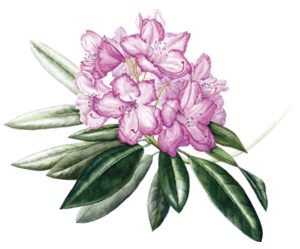 The RGC meeting in August was all about getting ready for the flower show in conjunction with the DeKalb County Fair. For years, the show was in September, so the August meeting traditionally was the final push to be ready. This year the fair is October 21-25, so we’re a month early in promoting things. The theme this year is “Night at the Movies,” and all the classes in the five divisions (Horticulture, Design, Botanical Arts, Education, and Youth) have movie titles. Anyone and everyone can enter arboreal, cut foliage, herbs, flowering annuals/perennials, bulbs, container-grown and hanging plants. Adults must bring entries in clear bottles this year since we won’t be using the wooden cases. Due to space availability, youth entries will be in a wooden case. We are encouraging the public to enter any and all worthy horticulture that they have grown. Cutting something off the side of the road is cheating! So is stealing something from the neighbor’s yard! Some people!
At a recently attended symposium, the horticulture instructor explained how and why the horticulture entry is written with very specific requirements. Common names can be confusing. The common daffodil may be called a buttercup, jonquil, or narcissus in another community. “A rose by any other name” does not work when identifying plants.
Linnaean taxonomy to the rescue. In the 1750’s, Carl Linnaeus developed a taxonomy in naming not only plants but animals and minerals as well. You can thank Linnaeus if you’ve ever answered the question, “Is it animal, vegetable, or mineral?” His Imperium Naturae listed Regnum Animale, Regnum Vegetabile and Regnum Lapideum. His system is a complex but organized way of naming, defining, and classifying groups based on shared characteristics. Latin, being a dead language, was chosen in the naming since its word meanings would be consistent, unchanged, and prevent confusion.
Simply put, botanical nomenclature is a scientific way of naming plants. With Binomial nomenclature (bi meaning two and nomial meaning name in Latin), plants are given two names. The first name is the genus, which is a proper noun. Like your name, it is always capitalized. The specific epithet (replacing species) is an adjective or descriptive word and is NOT capitalized. If being typed, both words would be italicized. Since it’s hard to print italics by hand, on the entry card, the genus and specific epithet will be underlined.
The symposium instructor, who was of a certain age and a former English professor, explained the underlining and italicized writing. She reminded folks that italics are used to signal a switch between English to another language or when quoting a book, movie, or song title. During her college, precomputer days, typewriters were the norm. A typewriter had no italics option, so if one quoted a title of a book or used another language (Latin), the shift key was engaged so that the line above the number six could be used to backtrack and underline the passage. Latin as “old Italian” is italicized, and the underlined botanical name is carried over from typewriter days.
Lots of verbiage to explain how someone needs to write an entry card for the upcoming flower show in October. The card must have the genus, specific epithet (formerly species). Ugh. That’s too hard. Not so fast, my friend. If you know the common name, it’s easy to type “What is the in binomial, scientific or botanical name of ___?” Plant societies have photos with scientific and cultivar names listed for varieties. Online searches do fail sometimes, so knowledgeable, friendly folks at check-in will help in filling out cards. The initial check-in for the flower show will be the covered arena (near to the livestock show and chicken house).
After the genus and specific epithet were determined, folks decided to invent a better mousetrap for plants and started cultivating, hybridizing, or breeding different varieties. That cultivated variety, or cultivar, received an additional special name, put in single quotes. Any plant that has been hybridized (rose, hosta, hydrangeas, zinnias, etc.) needs to have a cultivar name included on the entry card. Coming after the genus and specific epithet, the cultivar name is capitalized, not underlined and enclosed in single quotes.
Say you want to enter a marigold. Genus name is Tagetes. The specific epithet is erecta, (Latin for upright). Cultivar name is ‘Jubilee,’ so on the card you would write Tagetes erecta ‘Jubilee’ with the common name (African Marigold) written under the binomial name.
Just come, bring your plants, and we’ll help you get them entered. See the Floral Designs, Botanical Arts Designs, the Education Exhibits, and Youth Division — always my favorite part of the flower show.
Next month the program will be on Roses (Genus Rosa) presented by RGC President Rhea Pirch. Meet at Moon Lake Library on the second Tuesday, Sept. 9 at 10 a.m. Fantastic forum with friendly folks and fabulous food!
Mentone Fall Festival Returns Saturday, Oct. 17
Lots of Good Food Choices and Opportunities to Sponsor Mentone is preparing to welcome thousands of visitors as the Mentone Fall Festival returns Saturday, Oct. 17, for a full day of art, music, food, and » Read More

High Temps? No Problem. Try These Cool Recipes
We’ve been spoiled most of the summer with rainy days, cloud cover, and highs in the 70s and low 80s. But today when I walked outside, I realized that luck might have run out. Corn » Read More

Valley Head Women’s Club Awards Scholarships
The Valley Head Area Women’s Club awarded two scholarships to the Valley Head High School Class of 2026. This year, the scholarships were increased in memory of JoAnn Phillips to a total value of $800 » Read More

A Bit of Our Town’s History
I decided to give you all a brief history lesson on our beautiful town this month. I even discovered a new fact or two myself. Valley Head was officially incorporated in 1922 and continues to » Read More