

Made in the Shade Gardening

Remember to participate in the GREAT POLLINATOR count on August 23. One plant, just 15 minutes spent counting the number of different insects that visit. Too bad the count wasn’t in July, because the St. John’s Wort bushes were literally buzzing.
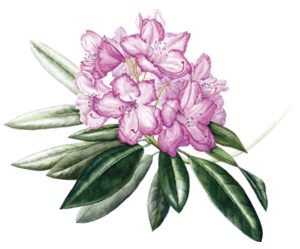 The Rhododendron Garden Club elves visited the Post Office bed and attacked the lovely vine that was taking over. Delighted to say it’s mostly weed free and freshly mulched. The plan is for the center evergreen to become a topiary. Hopefully, the fairy garden and planter will stay in situ.
Pat Parmelee, library volunteer extraordinaire, RGC member, and DeKalb County Master Gardener president, gave an informative and colorful presentation on shade gardens. Creating her own shade garden has provided lots of insights into dos and don’ts. Shade gardening is tricky, and seasonal issues must be factored into choosing plantings. Absence of leaves in the winter garden vs. full shade in the summer can be a space where bulbs, ephemerals, and annuals will thrive since they bloom early and die back before the heat of summer. Pat suggested a period of observation for a year, noting what areas of the yard stayed in full sun, partial sun/shade, or full shade.
Full sun is defined as six to eight hours of mid-summer sun. Partial or semi-shade is three to six hours. Dappled shade is diffused sun, peeking through the canopy. Moderate shade is two to three hours of direct sunlight, and deep shade is less than two hours. Matching plants to the amount of sun they require is the start of any successful garden.
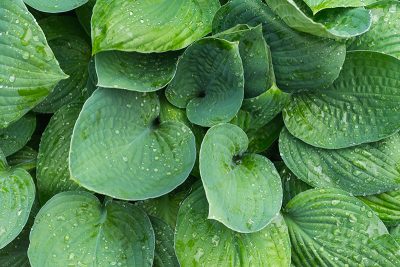 Avoid the guilt of plant graveyards by matching plants with their preferred shade, water, and soil conditions. Hosta’s failure to thrive could be because they prefer a soil with a pH of 6.5-7 and NOT wet soil, especially in winter. Choose wisely. Maybe don’t plant under the pine tree but do put in a raised bed for drainage. With the mountain rocks, clay, or acid soils, raised beds are always an option. Oh, for the soil of Sand Mountain.
Consider function and aesthetics when planning the hardscape. Paths placed in wet areas create interest and keep feet dry. Beds can be created along those walkways and highlighted with lighting. Large drifts of plants make an impact. Deep shade gardens won’t support sun for flowers, so foliage plants take the lead. Variations in color, texture, and shiny or matte leaves are critical for a shade garden. Shiny leaves will pop, while leaves with a matte finish recede. Repeating those textures, colors, and plant species throughout the garden unifies and pleases.
Plan the garden using all the senses. Including structures to attract birds or adding a wind chime can engage the auditory. Olfactory is stimulated with odiferous plants like edgeworthia. Vertical features and yard art visually enhance lush plantings. The feel of moss underfoot is a pleasure all its own. A shade garden can be a restful sanctuary.
A plus of shade gardens is that they use less fertilizers and water. Close plantings can reduce weeds and seedlings (plus) but may cause fungal infections (minus). Holes in foliage and trails of slime are indicators of slugs (no shell) or snails (with shell). They can be a huge minus, but things can be done to control their damage. They only feed at night, so grab that headlamp and a bucket and go hunting. Slugs can be beneficial in the compost, speeding the process of decomposition, so relocate them to the heap. Dampened cardboard or a board can be laid on the ground around plantings. Check in the morning for slugs underneath. They can’t resist beer, so put out a container for death by alcohol. For folks who do not imbibe, an effective alternative is mixing equal parts flour and water with a heaping teaspoon of molasses, a sprinkling of cornmeal, and a teaspoon of yeast. Another option is diatomaceous earth (DE), a naturally occurring silica-based substance as a barrier that slugs prefer NOT crossing. DE needs dry conditions so is ineffective after a rain. For aversion therapy, a 1-inch band of copper around a pot will zap the slug with a “shock-like” sensation.
Pat completed her presentation with several beautiful slides with options for all degrees of shade gardens. Too many to list here but always available online. Pick a shade corner and get started. Her last comment was, “If you’ve tried everything and can’t get a shade garden growing, there’s mushrooms.”
Next month, our speakers will be Martha Wood and Mellanie Tuttle. The Fair/Fall Federation flower show has always been in September (except last year, and this year it’s in October), so August was time for all things flower show. We’ll discuss floral designs, botanical arts designs, and how to prepare horticulture to get those blue ribbons! The public is invited to enter horticulture. Now is the time to make terrariums, dish gardens, and container-grown plants. There’s just enough time to plant some annuals! It’s so much fun!
Mentone Fall Festival Returns Saturday, Oct. 17
Lots of Good Food Choices and Opportunities to Sponsor Mentone is preparing to welcome thousands of visitors as the Mentone Fall Festival returns Saturday, Oct. 17, for a full day of art, music, food, and » Read More
High Temps? No Problem. Try These Cool Recipes
We’ve been spoiled most of the summer with rainy days, cloud cover, and highs in the 70s and low 80s. But today when I walked outside, I realized that luck might have run out. Corn » Read More

Valley Head Women’s Club Awards Scholarships
The Valley Head Area Women’s Club awarded two scholarships to the Valley Head High School Class of 2026. This year, the scholarships were increased in memory of JoAnn Phillips to a total value of $800 » Read More

A Bit of Our Town’s History
I decided to give you all a brief history lesson on our beautiful town this month. I even discovered a new fact or two myself. Valley Head was officially incorporated in 1922 and continues to » Read More