

Mulch Magic

This is the fourth in a series of articles on regenerative agriculture, featuring local residents involved in the movement.
Mulching is an elegant activity. It produces a host of benefits in the garden, while requiring the least amount of effort. Mulch is a weed killer, moisture and temperature regulator, soil conditioner, bug suppressor, and fertilizer. It accomplishes all this organically, without costly toxic chemicals. It minimizes the use of a hoe or tiller, and moving hay with a pitchfork is more ergonomically fit.
Supplies of mulch are plentiful and close at hand. There is no need for a complicated supply chain. It grows all around us. My wife, Rebecca, and I gardened for over 40 years the “progressive” way, fighting weeds on uncovered soil. The work was productive, but hard and unceasing. One day, a young permaculture teacher named Markus Thompson came by the house. He took one look at our garden and said, “You need to cover it all up.” He pointed to the trees around us and added, “That forest stays covered up, and it has its own protection and fertilizing system. You should try something similar.” I was incredulous.
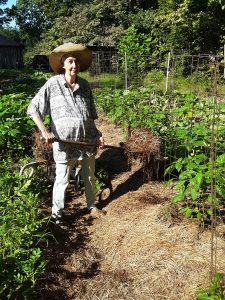
Rebecca Adams pitching hay.
Who was this punk telling me about such an unfamiliar idea? After considering his advice for a while, I realized he was right. We had been doing things backward for a long time. We began mulching with the fall leaves. We covered the walking rows between the raised beds with a thick layer, raked from our yard and driveway. We bought several bales of old hay from a farmer who always harvested before any seeds were viable. The hay covered our raised beds. Short fescue worked well and was plentiful and inexpensive in the Lookout Mountain area.
The first positive effect noticed was a drastic reduction of weeds. We rolled the bales out next to the rows and pitched thick mats of hay onto the raised beds. The unwanted greenery was mostly smothered by the first layer. Extra layers were applied later to kill the few weeds that sprang through thin areas. It took time and continued mulching to break the cycle of residual seeds emerging. Patience and persistence paid off. At planting time, we separated the hay wide enough to make room for seeds. A liberal use of hay is recommended at first. Do not allow weeds to develop seeds before covering them!
We soon saw a change in soil moisture and temperature extremes. Erosion was eliminated, and water retention increased. No more ankle-deep mud following a downpour! Correspondingly, the soil became moist, fluffy, and easy to work in. Our worm population began to increase. They seemed to thrive under the thermal moisture blanket. This protective insulation also helped other organic life thrive. Nitrogen-fixing bacteria produced more nutrients in this regulated environment. Everything in the earth seemed to like being cooler in summer and warmer in winter. It was more of a Goldilocks world.
After the garden had been covered completely for a few years, a new benefit arose. Bug pests diminished steadily. Grasshoppers, crickets, aphids, ants, shield bugs, bean beetles, Japanese beetles, horn worms, and others became almost absent. We theorize that the lack of weeds deprived pests of places to propagate. This is a theory we continue to study. There has also been a decrease in beneficial critters, like preying mantis, ladybug beetles, and assassin bugs. They have less to eat.
Mulch serves one last purpose as it rots over time. It turns slowly into a nutrient-rich fertilizer in the form of compost spread out at the plant roots. It also feeds and protects nitrogen-fixing bacteria essential for terra preta soil. It became apparent that we were transitioning to an easier no-till gardening system. We dug down less and added more on top. We embraced and emulated objective, natural systems and abandoned subjective mechanical, chemical ones. Life has become easier and more satisfying. Happiness is our blessing for hard, productive work.
Mentone Fall Festival Returns Saturday, Oct. 17
Lots of Good Food Choices and Opportunities to Sponsor Mentone is preparing to welcome thousands of visitors as the Mentone Fall Festival returns Saturday, Oct. 17, for a full day of art, music, food, and » Read More

High Temps? No Problem. Try These Cool Recipes
We’ve been spoiled most of the summer with rainy days, cloud cover, and highs in the 70s and low 80s. But today when I walked outside, I realized that luck might have run out. Corn » Read More

Valley Head Women’s Club Awards Scholarships
The Valley Head Area Women’s Club awarded two scholarships to the Valley Head High School Class of 2026. This year, the scholarships were increased in memory of JoAnn Phillips to a total value of $800 » Read More

A Bit of Our Town’s History
I decided to give you all a brief history lesson on our beautiful town this month. I even discovered a new fact or two myself. Valley Head was officially incorporated in 1922 and continues to » Read More