

One Couple’s Journey to Living Lightly on the Land

This is the fifth in a series of articles on regenerative agriculture, featuring local residents involved in the movement.
My father was a child of the Great Depression. He learned early on that you had to make do with what you had, to fix what was broken, and to make what you needed but couldn’t afford to buy. He was by nature and his service a member of the Greatest Generation. I am his son. My partner Carolyn Smith’s parents were the same. Her father was a Marine artillery officer on Guadalcanal, my father a B-17 gunner. We both grew up with their belief that if you wanted or needed something done, you did it yourself. So, when I suggested to her that we leave our city life in Atlanta and head out to live in the country, she was interested.
We wanted to be far from the noise of highways and airports, from sirens and alarms. Far from the perpetual twilight of the city night. We wanted the peace and tranquility of nature. We wanted to see the Milky Way on a clear winter night, to hear the spring peepers, to smell the aroma of leaves decomposing on the forest floor. We wanted to live within this with as little impact as possible.
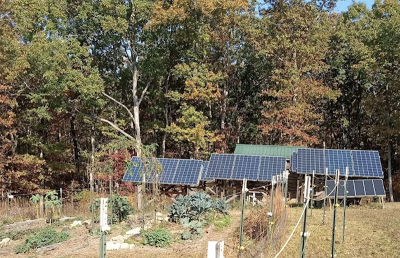
Russell and Carolyn’s garden in the woods.
After three or four years of saving and searching, we found our place on Lookout Mountain: 40 acres of trees and sandstone boulders. We arrived at the Fort Payne office of our closing attorney on a Friday afternoon with our car packed with camping equipment and a few hand tools. Using a hand saw and pruning shears, we cleared traces of a 50 year-old logging road. Our intention was to reach a place on the property suitable for a small house and garden.
Neither of us wanted to go deep into debt, because retirement was just a few years away. Our building plans were put on hold for five years while the property was paid off. Meanwhile, we continued working and living in Atlanta. We came up just about every Friday night after work to enjoy camping here, immersed in the sights, sounds and smells of the natural world.
When the land was paid off, we started applying our income to building materials. The first building was a small metal shed for storing tools. The second was an outhouse that we pre-fabbed in the front yard in Atlanta. Our Brookhaven neighbors were amused, “What are you all doing over here?” Laughter when we said, “Building an outhouse.” The third building was a shower house with a propane water heater. We were approaching a state of glamping.
The cabin took several years to complete, usually working by ourselves on weekends when it wasn’t raining. We had decided, for environmental reasons, to see how much salvage we could use for the 16- x 24-foot one-room cabin. Many of the materials were found, donated, salvaged, or purchased at the Atlanta Habitat for Humanity ReStore. Others were purchased from nearby sawmills, salvage stores, or building supply companies.
Our first electric power was a 45-watt solar panel, three car batteries, and a 300-watt inverter. This was enough to run an LED lamp and a tiny refrigerator — a definite step up from a propane lantern and ice chest. Carolyn had an unused cast iron wood stove at her Atlanta house that she donated to the cause. It did an outstanding job of heating that one-room house. Camping was over.
Our original plan was to have commercial water and electricity supplied to us through underground conduits. We didn’t want to slash a 30-foot-wide gash through our beautiful forest. Unfortunately, the presence of many sandstone boulders presented an unreasonable cost barrier for underground utilities so we turned to solar power and well water.
We cut only those trees necessary to wedge in the footprint of our small cabin. The same philosophy applied to all of our projects. Clear only what you absolutely need. When it was time to install a larger solar array, it was difficult to acknowledge that quite a few healthy trees had to be removed. Realizing that the now cleared space would make a wonderful vegetable garden was a healing balm on that wound.
We realized from the beginning that the soil needed some amending to grow anything. We started learning all we could about sustainable agriculture, composting, mulching, hugelkultur, permaculture, and organic farming. Our first garden bed was a kind of inverted hugelkultur mound. We dug a 2-foot deep, 3-foot-wide trench, 20 feet long. Then we built a kind of wood and earthen lasagna: a layer of dead wood in the bottom of the trench, followed by a layer of the soil we had removed, carefully filling the voids. Then another layer of wood followed by a layer of soil — layer by layer in this manner until the trench was refilled, leaving us with a raised bed.
This method is very good for holding moisture, but the downside is that in the short term, there is a nitrogen deficiency. To compensate, we added a few ounces of 33-0-0 to each layer. In addition, we now compost all of our kitchen vegetable scraps directly into the beds, just digging a little trench and burying it. As time goes on and the wood rots, nitrogen is slowly returned. Today, we have eight such beds and several smaller ones, each covered with a mulch layer of wood chips or leaves. Over the years, as the wood has rotted, the beds have sunk. Just this year, we topped them up with new soil. We’re constantly making new soil: piling up leaves, grass clippings, sandy soil, and so forth in the woods. We always have it on hand.
To attract the pollinators, Carolyn has planted an assortment of brightly colored flowers throughout the garden. We have also transplanted Hoary Mountain Mint into the garden. This native “weed” attracts an extraordinary variety of pollinators, especially predatory wasps.
That’s our life! We’re retired now and enjoying what we’ve built so far. Yes, we have more projects planned! And of course there’s maintenance. But when we look around, there’s mainly a huge sense of accomplishment and satisfaction. Especially knowing that we have been gentle on our land.
BY RUSSELL POUNCEY
Mentone Fall Festival Returns Saturday, Oct. 17
Lots of Good Food Choices and Opportunities to Sponsor Mentone is preparing to welcome thousands of visitors as the Mentone Fall Festival returns Saturday, Oct. 17, for a full day of art, music, food, and » Read More
High Temps? No Problem. Try These Cool Recipes
We’ve been spoiled most of the summer with rainy days, cloud cover, and highs in the 70s and low 80s. But today when I walked outside, I realized that luck might have run out. Corn » Read More

Valley Head Women’s Club Awards Scholarships
The Valley Head Area Women’s Club awarded two scholarships to the Valley Head High School Class of 2026. This year, the scholarships were increased in memory of JoAnn Phillips to a total value of $800 » Read More

A Bit of Our Town’s History
I decided to give you all a brief history lesson on our beautiful town this month. I even discovered a new fact or two myself. Valley Head was officially incorporated in 1922 and continues to » Read More