

RGC Learns About the Honeybee

Thanks to Rebecca Henderson whose brilliant editing fine tuned last month’s ramblings. Her name should have been in the by-line for all her efforts.
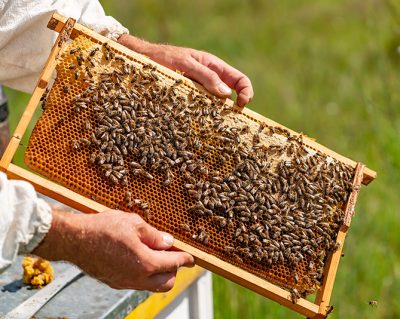
The beekeeper examines the frames with honey. Beekeeper holding frame of honeycomb with working bees outdoor.
In our meeting, Lee Hudson spoke to the RGC about his adventures with the honeybee. A transplant from Indiana with training in holistic health, Lee has spent over 20 years raising honeybees. He now lives in Rising Fawn, Georgia, with his very southern-speaking wife. His own brand of honey is named Well Honey (but pronounced Wail Hunney). Lee has partnered with Derick Forester of Forester Farms and Apiary in Rising Fawn and mentors those interested in keeping bees. He also sells all things related to honeybees.
Buy local. Lee has 60 hive boxes on half an acre, but he also spreads the hives around Northeast Alabama, Northwest Georgia, and Tennessee. Have bee will travel to your property. Call Lee to arrange a delivery of bees, order equipment, or ask for advice. 423-802-6466.
Buy raw, not processed. Raw honey should never mold. China-grown honey will often have water or high fructose corn syrup added. If honey crystallizes, place the jar in warm, not boiling water. Temperatures higher than 105 Fahrenheit will destroy the antibacterial, anti-fungal, and antioxidant benefits.
Taste, color, and texture vary depending on the source of pollen. Spring honey is dark, while fall’s goldenrod honey is a very light color but not the best flavor. Floral honey is said to be most effective against allergies. Clover, sourwood, or orange blossom honey (read the label) won’t help allergies unless one is allergic to those plants. Eating the local honey when traveling overseas could also cause a reaction, so beware. One person’s medicine is another’s poison. The American Academy of Pediatrics strongly discourages giving honey to kids under the age of 1, because it can cause botulism, which is a rare and life-threatening condition that attacks the body’s nervous system.
The “bees knees” for learning about the colony life of a honeybee is the Arizona State University website (askabiologist.asu.edu). Videos of the queen laying eggs or an emerging female being serenaded with the buzz-buzzing of thousands of sister bees doing their work is fascinating. Every bee colony has one queen that controls all aspects of the hive and lays an average of 1,500 eggs a day. Bees start as eggs, hatch into larvae, becoming pupae, and finally emerge as the fuzzy bee. From larva to adult takes about 21 days.
All worker bees are female. The youngest workers take care of the queen and the young larvae. Wax from glands in their stomachs produce the honeycomb structure. As they mature, jobs will change depending on what the hive needs. Indoor workers transition to outside where they forage; collecting nectar, pollen, and water. The nectar acts as the main energy source, and pollen is fed to the larvae for protein. The male drones don’t have stingers, and their only job is to search for new queens looking to mate. They represent about 10-15% of the hive population.
The colony swarms when it gets too big for its space. Special wax cells are built to raise a new queen. The old queen moves out and takes half the colony with her. The new queen stays to start a new colony.
Honeybees (Apis mellifera) are not native to North America. What? Nope. The German honeybees appeared on U.S. land in the 1600s and rapidly became established across the country. Italian bees, imported in 1857 because of their docile nature, are susceptible to the parasitic varroa mite. A Russian species resistant to the mite was introduced in 1997.
Why aren’t honeybees treated as an invasive species? After four hundred years, the honeybee is a domesticated species like chickens or livestock. As a $15 billion industry, honeybees are vital to the food supply, pollinating one-third of the food eaten. Declining native bee populations get overlooked in the Save the Bees campaign. Research is ongoing in the Native vs. Non-Native Bee Debate. Researcher Ron Miksha talks of compromise. “While non-natives may enhance pollination, concerns arise about potential competition with native species, disease transmission, and disruption of ecosystems. Striking a balance between agricultural needs and conservation is crucial for sustainable bee management.” Amen. Bee happy!
June 10 is a clean-up day. Please note: Meeting time at the library is 9 a.m. instead of 10 a.m. BYO gloves, hats, shovels, shears, and trowels. Water and snacks will be provided. Maybe it’ll rain. Just kidding.
Mentone Fall Festival Returns Saturday, Oct. 17
Lots of Good Food Choices and Opportunities to Sponsor Mentone is preparing to welcome thousands of visitors as the Mentone Fall Festival returns Saturday, Oct. 17, for a full day of art, music, food, and » Read More
High Temps? No Problem. Try These Cool Recipes
We’ve been spoiled most of the summer with rainy days, cloud cover, and highs in the 70s and low 80s. But today when I walked outside, I realized that luck might have run out. Corn » Read More
Valley Head Women’s Club Awards Scholarships
The Valley Head Area Women’s Club awarded two scholarships to the Valley Head High School Class of 2026. This year, the scholarships were increased in memory of JoAnn Phillips to a total value of $800 » Read More
A Bit of Our Town’s History
I decided to give you all a brief history lesson on our beautiful town this month. I even discovered a new fact or two myself. Valley Head was officially incorporated in 1922 and continues to » Read More