

RGC’s Annual Clean-Up and the Buzz About Bees

In June, the RGC had its annual clean-up around the Moon Lake Campus. Trees and shrubs were pruned; weeds were pulled; limbs were loaded onto the berm. Whoo hoo and thanks to all who were able to help. Vacationers and those claiming old bones were excused from duty. No animals were harmed in the process.
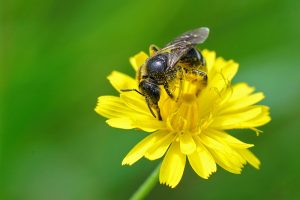 And Now a Word About Bees
Solitary bees are amazing. Most native bees in the U.S. are solitary. No hives. No honey. No drones or worker bees to help. They make up 98% of the native bee species and have a pollination success rate of 95%. The non-native honeybee success rate is 5%. Solitary bees are the James Brown and Rodney Dangerfield of the bee world!
Carpenter bees, mason bees, leaf cutter bees, and sweat bees vary in size, color, shape, behavior, and nesting site preference, but their commonality is solitary living. The mason bee (Osmia) female prefers nesting in naturally occurring tubular cavities. After mating, she will begin collecting pollen and nectar to build a mass. Once the mass is large enough, she then backs into the tube, laying an egg on top of the mass. She creates a wall of mud to enclose the egg and repeats the process until the tube is filled. She plugs the entrance and may build another nest. The egg hatches, consumes its pollen mass, and during the larval stage spins a cocoon around itself for the pupal stage. The adult matures in the fall or winter and hibernates in the cocoon until emerging in the spring. Front eggs hatch as males, the back ones are female. Only female bees have a scopa, which is used to transport pollen. Males never transport pollen and do not have stingers — their only role is to mate. The Osmia scopa, located under her abdomen (not on the hind legs like most bees) allows for almost 100 percent pollination. Farmers love the mason bee.
If your rose bush leaves have semi-circular cuts, the leaf-cutter bee (Megachile rotundata) is the culprit. Be ecstatic! There’s minimal damage to the plant, and wonderful pollinators are nearby. Instead of mud, leaf-cutter bees use those pieces of leaves to line their nests and make the walls between the eggs.
Ground nesting bees: do not confuse the solitary gentle bees with the yellowjacket, an aggressive social wasp. Don’t pour gasoline, water, or pesticide down the bee hole, please! Solitary bees rarely sting. It may seem like a swarm of metallic bees or honeybee look-alikes emerging from the ground in spring, but it’s actually because ground bees nest in large aggregates. Multiple nesting holes are closely located but each nesting site is made by a solitary bee. It’s like a bee townhome community. Some species will use the same mud tunnels year after year. Plasterer bees (Colletidae) smooth their nest walls into a cellophane-like lining. Miners bees (Andrenidae) love to excavate and pollinate blueberries. Sweat bees (Halictidae) are attracted to perspiration. Don’t panic. Most stinging occurs when swatting at a female. The dissolved electrolytes on the skin is the big attraction, so let them lick your skin.
Of the 4,000 native bees in the United States, the bumblebee (Bombus hymorum) is the only social bee. The female builds a nest, creates a caste system, and produces a wax-like honey substance. But no one is harvesting bumblebee honey, and unlike the structured hexagonal honeybee hive, bumblebee nests are messy and seldom seen. Imagine a smallish-sized football lined with grassy fibers containing waxy pots that look like caramel popcorn. Depending on the species, some build underground in abandoned rodent holes, or on the surface of the grounds in mossy vegetation or even in tree hollows or bird boxes. Wildflowers, tomatoes, peppers, and cranberries benefit from “buzz pollination” where the bumblebee jaw grasps a flower and then vibrates its wings to dislodge the pollen.
A fun project to do with the grands this summer is to make a Bee Hotel. One YouTube site gave directions for drilling 5-6 inch holes into a log using ¼- and ⅜-inch drill bits. Be sure to sand around the holes so no splinters are left to damage fragile wings. This could be an alternate wood option for those pesky carpenter bees. A viewer was concerned about being able to clean the tubes after the bees emerged. A can or wooden structure filled with paper straws will solve that problem. The Ritz-Carlton of Bee Hotels is stacked pallets, openings stuffed with leaves, pine cones, sticks, tubes, and bricks. Whatever the size or style, hotels should have full morning sun and be placed 100-200 yards from the pollen source and 50 yards from a mud source.
For ground nesting bees, don’t spray the yard with pesticides. Leave some areas unmulched so tunneling is easy. Allow the fall leaves to stay for site protection over the winter.
The July 8 RGC meeting will be held in the library at 10 a.m. Pat Parmelee, RGC member and Master Gardener, will present a program on Shade Gardens. Ah, lovely shade in the heat of summer.
Mentone Fall Festival Returns Saturday, Oct. 17
Lots of Good Food Choices and Opportunities to Sponsor Mentone is preparing to welcome thousands of visitors as the Mentone Fall Festival returns Saturday, Oct. 17, for a full day of art, music, food, and » Read More

High Temps? No Problem. Try These Cool Recipes
We’ve been spoiled most of the summer with rainy days, cloud cover, and highs in the 70s and low 80s. But today when I walked outside, I realized that luck might have run out. Corn » Read More

Valley Head Women’s Club Awards Scholarships
The Valley Head Area Women’s Club awarded two scholarships to the Valley Head High School Class of 2026. This year, the scholarships were increased in memory of JoAnn Phillips to a total value of $800 » Read More

A Bit of Our Town’s History
I decided to give you all a brief history lesson on our beautiful town this month. I even discovered a new fact or two myself. Valley Head was officially incorporated in 1922 and continues to » Read More