

The U.S. Navy Flag Explained

The flag of the United States Navy, often a source of confusion for the general public, is a powerful symbol of the nation’s maritime power and heritage. Unlike the more commonly recognized flags of the Army, Marine Corps, and Air Force, the Navy’s official flag is not the one most people associate with naval vessels. This article explores the history, design, and significance of the U.S. Navy flag and other important flags used by the service.
 A Brief History
The U.S. Navy did not have an official flag for many years. Early naval vessels flew the national ensign (the Stars and Stripes) to identify their nationality. However, as the service grew and its missions expanded, there was a need for a unique flag to represent the Navy itself. The current official flag of the U.S. Navy was formally adopted on April 24, 1959. Its design reflected the Navy’s history and mission.
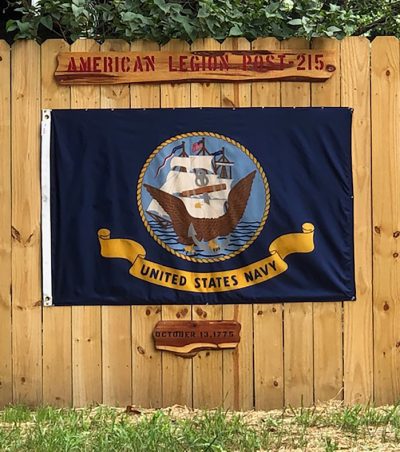
The official U.S. Navy flag is a distinctive and symbolic design. It consists of a dark blue field with the seal of the Department of the Navy in the center.
The seal is a prominent feature of the flag. It depicts an eagle with its wings spread, perched on an anchor, with a Constitution-class frigate sailing on the sea below.
This seal was originally adopted in 1957. The eagle represents the United States, signifying the Navy’s role in protecting the nation’s interests. The anchor is a traditional symbol of naval service, representing stability and steadfastness. The ship represents the seagoing nature of the Navy and its history. The Constitution-class frigate is a nod to early American naval power. Below the seal, a ribbon bears the Latin motto, NON SIBI SED PATRIAE, which translates to “Not for Self but for Country.” The flag is used at official ceremonies, parades, and in the offices of high-ranking naval officials. It is a symbol of the Navy as a whole, representing its command structure and authority.
The Navy Jack: A Source of Confusion
One of the most common sources of confusion about Navy flags is the Navy Jack. Many people mistakenly believe the Navy Jack is the official flag of the service.
• The original Navy Jack, used from 1775 to 1975, was a striped flag with a rattlesnake and the motto “DON’T TREAD ON ME.” This flag, known as the Gadsden flag, was originally used by Continental Navy ships and was a symbol of American defiance.
• The Union Jack: For many years, U.S. naval vessels flew the “Union Jack,” a flag consisting of a blue field with white stars, representing the union of the states.
• The Return of the First Navy Jack: Following the September 11, 2001, attacks, Secretary of the Navy Gordon R. England directed that all U.S. naval vessels would fly the First Navy Jack, with the rattlesnake and “DON’T TREAD ON ME” motto, “for the duration of the Global War on Terrorism.” This move was intended to be a symbol of historical resolve and the Navy’s fighting spirit.
Other Important Navy Flags
In addition to the official flag and the Navy Jack, the U.S. Navy uses a variety of other flags and pennants for different purposes.
• The National Ensign (Stars and Stripes): The most important flag flown by all U.S. naval vessels is the national ensign. When a ship is in port, the ensign is hoisted at the stern. At sea, it is flown from the gaff. This flag signifies the ship’s nationality and is a symbol of American sovereignty.
• Rank Flags: Admirals and other flag officers have their own personal flags to denote their presence and rank. For example, a four-star admiral’s flag is blue with four white stars.
• Commissioning pennant: When a ship is in commission, it flies a long, narrow pennant called a commissioning pennant, a symbol of the ship’s active status and authority.
The flags of the U.S. Navy are more than just pieces of cloth. They are deeply symbolic representations of the service’s history, values, and mission. From the official flag with its powerful seal and motto to the defiant First Navy Jack and the ever-present national ensign, each flag tells a part of the story of the United States Navy and the men and women who serve within its ranks. Understanding these flags is key to appreciating the rich traditions and enduring legacy of America’s naval power.
Memories From Novembers Past
I recently decided to take a few minutes to look back into archived November issues of The Groundhog. Those few minutes turned into a few hours, as I squinted and read about familiar (and some » Read More

Extra Thanksgiving Ingredients
Thanksgiving isn’t far off, and I plan to cook the whole shebang for my family. But one thing I have to have after the big day is something different to eat — preferably something with » Read More
There’s a New Bear in Town
Uber-talented Mentone artist Don Highfield has given Mentone a new landmark: an 8-foot-tall bear carved from a pine tree that was slated to come down. Next time you head over to Little River Hardware » Read More
Valley Head Women’s Club Bake Sale and Pecan Fundraiser
Come out and buy something delicious at the Valley Head Women’s Club’s annual fundraising bake sale November 21 from 9 a.m. to 1 p.m. (or until items are sold out). Choose from homemade desserts, breads, » Read More