

Catching Rainwater for Home and Garden

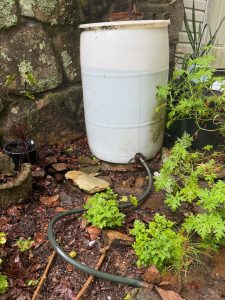 Rhododendron Garden Club member Helen Allen shared the joys, triumphs, challenges, and trials in perfecting her rainwater catchment system. It supplies water to her house in addition to another system used to water the garden. She explained how the designs came together, offered helpful suggestions and warnings of what not to do, and listed resources for those just getting started.
Most roof surfaces are suitable for rainwater harvesting if one wants to just water a garden. The American Rainwater Catchment Systems Association (ARCSA) advises that “standing seam roofs, powder coated or enameled, Galvalume (zinc + aluminum alloy) with non-toxic baked or enamel finish are appropriate for potable use with non-toxic finishes and appropriate components, tanks, and post-tank treatment.” Home test kits or ones sent to labs can check the pH as well as contaminants such as zinc, iron, toxins, and bacteria. Adhesives in asphalt roofs do most of their off-gassing in the first year, so avoid irrigating edibles for that period. Also, avoid cedar shake, copper, lead, or rooftops treated with biocides. If plants are looking sad where rainwater hits the ground, rooftop zinc levels may be high — not a good choice for rain harvesting.
Most folks will not need a 3,000-gallon tank, diverter line, pump, insulated and heated pipes, and pressure tank that Helen uses for her home. Helen had drilled a well but the water was filled with iron, so she bought a filter system. That did not solve the problem of low volume. Rain barrels to the rescue! She has enough water for house and garden. Calculating water needs will determine quantity and size of the containers. How much water can you catch? How much water do you need? How much space do you want to dedicate to water storage? Blue Barrel Systems offers a rain catchment calculator to help with those questions. Start with a 55-gallon barrel or drum and add on accordingly.
Helen recommended getting a barrel that is not clear or white. Blue, dark, or painted barrels will block sunlight and discourage algae growth. Obviously, get only food grade drums and be sure to check sources. Barrels can be purchased with the faucet and connections, but it’s not that complicated to DIY. Elevate the barrel/drum since gravity makes it difficult for water to flow up! A barrel with an open top makes it easier to clean but also attracts mosquitoes. Cover with mesh or use mosquito dunks.
Thank goodness Alabama is a state where it is not illegal to have rain barrels. Helen wins the award for problem-solving and water harvesting. She’s happy to share her expertise.
The next meeting will be August 11 at 10 a.m. The club is gathering at Little River Orchard on 4594 E. River Road. Join us for pickin’ and grinnin’!
Did you know we have a Facebook page? Follow us at www.facebook.com/rhododendrongardenclub to receive gardening tips, get updates on our activities and “like” us!
Mentone Fall Festival Returns Saturday, Oct. 17
Lots of Good Food Choices and Opportunities to Sponsor Mentone is preparing to welcome thousands of visitors as the Mentone Fall Festival returns Saturday, Oct. 17, for a full day of art, music, food, and » Read More

High Temps? No Problem. Try These Cool Recipes
We’ve been spoiled most of the summer with rainy days, cloud cover, and highs in the 70s and low 80s. But today when I walked outside, I realized that luck might have run out. Corn » Read More

Valley Head Women’s Club Awards Scholarships
The Valley Head Area Women’s Club awarded two scholarships to the Valley Head High School Class of 2026. This year, the scholarships were increased in memory of JoAnn Phillips to a total value of $800 » Read More

A Bit of Our Town’s History
I decided to give you all a brief history lesson on our beautiful town this month. I even discovered a new fact or two myself. Valley Head was officially incorporated in 1922 and continues to » Read More