

The Buzz About Bees: Valley Head Teacher Helps Others Discover Beekeeping
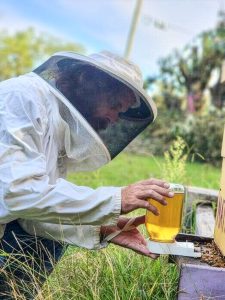 As Cameron Mitchell points out, honeybees have a role in history, science, agriculture, craftsmanship, environmental stewardship, and community all rolled into one ecosystem.
Mitchell, who teaches agriculture at Valley Head School, has spent the past decade teaching students about farming, livestock, woodworking, and the natural world. Somewhere along the way, bees became a passion for him.
After only a few minutes talking with him, it is easy to understand why. He’s been teaching for 14 years and has spent the past 10 at Valley Head. A native of Rainsville and graduate of Plainview High School, he earned his undergraduate degree from Auburn University before completing a master’s degree in adult agricultural education from Iowa State University in 2020.
His path back home to Northeast Alabama felt natural. “I couldn’t say no,” he said of returning to the area.
Mitchell’s fascination with beekeeping began in 2014 while he was teaching agriculture in Scottsboro. One of his mentors, longtime beekeeper and agriculture teacher J.R. Poe, invited him to a meeting of the Jackson County Beekeepers Association, a very active group.
“That’s what started my interest,” Mitchell said. “He was one of my heroes.”
At the same time, one of Mitchell’s students was raising bees for an agricultural proficiency project. Mitchell helped the student document the work and take photographs, and the student eventually won first place in a state agricultural processing competition with his bees.
“I thought I needed to learn a little bit about bees,” Mitchell said. “Then it just went from there.” While working on his graduate degree at Iowa State, Mitchell realized there was a need for more agricultural education focused specifically on honeybees.
“I told them we really needed a honeybee curriculum,” he said. “So, they approved it and I started doing my research with honeybees. I read a bunch of books and kept a lot of bees and really studied it.”
Today, he keeps a dozen colonies of bees himself and has developed a beginning beekeeping curriculum for high school students. And he hopes to share that knowledge not only with students, but with adults in the community who may be interested in learning the craft.
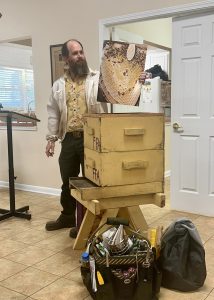 Beekeeping 101: Location, Location, Location
Obviously there is a lot to know before becoming a beekeeper. Mitchell stresses that first and foremost, location matters. “If you’re wanting to keep bees and you’re looking for a site, you always want to keep them on high ground in full sun.” Low, damp areas can invite pests, while shaded hives are more susceptible to hive beetles.
Mitchell says beginners can get started with a basic hive kit for around $100 from the local co-op or farm store, though he prefers building his own equipment alongside his students. “If you’re into woodworking, beekeeping goes hand in hand with that,” he said.
Aspiring beekeepers can buy equipment locally, order bees with a bred queen through suppliers or purchase a nucleus colony, or “nuc” — small starter colony — from regional breeders. Be wary of buying used equipment, he says. “There’s probably a reason that person got out of it, and that could be pests or diseases that are still in the box.”
Mitchell learned much of the craft from older beekeepers willing to share their knowledge. A veteran beekeeper spent time showing Mitchell how to create a hive. “He taught me how to build a nuc first, which is a small five-frame hive.”
Mitchell’s favorite way to get bees is a little more adventurous: “I like catching bees,” he said. Using swarm traps baited with lemongrass oil that mimics a queen’s swarm pheromone, Mitchell attracts scout bees searching for a new home. “They pretty much take a vote, and they’ll move into that box,” he said.
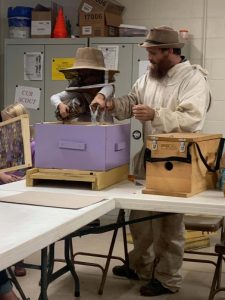 A Superorganism at Work
Spend enough time around Mitchell, and the conversation quickly turns from practical beekeeping to the astonishing biology inside a colony. A healthy colony can contain as many as 50,000 bees, each serving a specific role.
“If you look at bees as a superorganism, it makes all the sense in the world. You’ve got like 50,000 bees working as one organism.” Worker bees begin life caring for larvae as nurse bees before graduating to guard duty and eventually becoming foragers capable of flying up to 5 miles in search of food. Bees also use landmarks, such as a white house or a barn or other structure and know they’re near their hive.
“The forager worker is the ultimate worker bee,” Mitchell says. Drones, meanwhile, have only one purpose: mating with the queen. “The drone does absolutely nothing,” Mitchell jokes. “The drone hopes to be the lucky guy that gets to mate with the queen.”
Mitchell delights in sharing the stranger details of bee biology. Queens can determine the sex of each egg they lay. If she fertilizes that egg, that bee will be a female worker. If she doesn’t fertilize the egg, the bee will become a drone. Worker bees live only about 40 days during summer but can survive several months through winter. Inside the colony, bees cluster together to regulate temperature with remarkable efficiency. “Inside that box, it can be up to 90 degrees with a foot of snow,” Mitchell says.
The Art of Letting Bees Be Bees
One of the most common mistakes new beekeepers make, Mitchell says, is hovering too much. “Bees are still pretty wild,” he said. “Every time you go through every frame, you are ripping apart their house.” New keepers often want to inspect their hives constantly, but too much interference can stress the colony. “You’ve got to let bees be bees and let them build out the propolis [a glue that bees use to strengthen the hive] and the comb,” he says. Every two weeks is fine to inspect your hives.
Managing swarms is another challenge. A swarm is the process in which the old queen and about half of the worker bees leave to find a new home, while the remaining bees in the original hive raise a new queen. Swarming usually happens in spring or early summer, and while a swarm might alarm the onlooker, the swarm is usually docile. They’re on their way to finding a new home and continuing reproduction. The process keeps the colony diversified naturally, with the old queen leaving alongside many of the hive’s strongest workers. When that happens, honey production often suffers. “If they swarm on you, then you may not get much honey at all that year,” Mitchell explained.
A beekeeper never takes all the honey from a hive, as bees need a certain amount to live through winter. Still, on a good year, sweet rewards can be substantial. Mitchell says he has “robbed” (the beekeeping term used for harvesting) around 45 gallons of honey in one year. He typically harvests honey once each year around the Fourth of July. The process involves removing frames, extracting honey with specialized equipment, filtering it, bottling it, and labeling jars.
“It’s a huge day,” he says. “It’s a lot of work.”
More Than Sweetness
Mitchell is quick to point out that honey is more than a pantry staple.
“Local honey is the best honey,” he says. “It’s medicinal. It’s antibacterial.” According to Mitchell, truly local honey comes from bees within about 30 miles of where a person lives. Because bees pollinate flowers throughout the surrounding area, many people believe consuming local honey can help ease seasonal allergies. Mitchell says he has experienced the benefits personally.
“I used to have really bad allergies,” he said. “But I have not had a problem with allergies in the past five, six, seven years.”
Beyond honey production, Mitchell emphasizes the enormous role bees play in agriculture and food production through pollination — a lesson he stresses with his students. “They’re an important insect for our environment and for our food and our grocery stores,” he says.
According to the U.S. Food and Drug Administration, honey bees are major contributors to our agriculture. They produce six hive products — honey, pollen, royal jelly, beeswax, propolis, and venom — that people use for nutritional and medicinal purposes.
Honey is the most valuable hive product. In 2019, U.S. honey bees produced 157 million pounds of honey worth more than $339 million, according to the USDA. Beeswax is the second most important hive product and is widely used in candles, cosmetics, pharmaceuticals, and polishes. However, the greatest value of honey bees comes from their role as crop pollinators. Bee pollination adds about $15 billion in crop value each year. Pollination itself is essential for flowering plants, which rely on the transfer of pollen between flower parts to reproduce.
Mitchell’s enthusiasm extends far beyond modern agriculture. He lights up talking about the long history of beekeeping across human civilization.
Humans have kept bees since ancient times, he says, with evidence of beekeeping found in Egyptian tombs. “The Romans kept bees,” he says. “The Viking culture as well. Whenever a Viking couple was married, they would send them off on an adventure with mead honey [a beverage containing fermented honey] and honey cakes. And that’s where we get the term honeymoon.”
He also notes that honey bees themselves are not native to North America. “They actually come from Europe, Africa, and Asia,” he explains. According to Mitchell, historical records show bees arriving in the American colonies as early as the 1640s. “They would strap the colonies to the bows of the ship,” he said of how they transported them across the Atlantic.
Passing It On
Mitchell hopes more people in Northeast Alabama will discover beekeeping, whether through local bee clubs, community workshops or future classes he hopes to teach. At Valley Head, he already sees the impact on students, though they don’t all begin keeping bees themselves. “Most importantly, they all understand how bees are crucial,” Mitchell said.
And for anyone with an interest, he is more than happy to keep spreading his bee knowledge.
“Hey,” he said, “I can talk bees all day.”
Beekeeping Resources
For those interested in starting their own bee colony, Mitchell says it’s easier than many people realize. Beginner beekeeping kits — which often include hive boxes, frames, protective gear, smokers, and basic tools — can be found at local farm supply stores and co-ops throughout Northeast Alabama, including locations such as the Fort Payne and Scottsboro Farmers Co-ops, Tractor Supply stores, and regional farm and garden suppliers. New beekeepers can also order starter kits and nucleus colonies from Alabama bee breeders and national suppliers that ship directly to the area.
Mitchell encourages beginners to connect with experienced beekeepers through local associations and clubs before purchasing bees. “You learn so much just by talking to people who have done it for years,” he said.
DeKalb County does not have a standalone county beekeeping association affiliated with the Alabama Beekeepers Association, but residents often participate in nearby regional clubs in Jackson, Etowah, Madison, and Calhoun counties. The Alabama Beekeepers Association maintains a statewide directory of local clubs and classes.

Medicare Open Enrollment for 2027 Is Here
Medicare Open Enrollment is upon us again. Every year from October 15 to December 7, Medicare beneficiaries have the opportunity to make changes to their Medicare Part D Prescription Drug plan or » Read More
DeSoto State Park: Something for Everyone in October
October is packed with opportunities to explore, learn, and enjoy the outdoors at DeSoto State Park. From guided hikes and campfire talks to creative workshops and Halloween fun, there’s something for nearly every age and » Read More

Get Your Fair Food Fix
Who doesn’t succumb to the heady aroma of fair and festival food? When faced with a decision between a Ferris wheel and fried batter of some sort … well, the decision is pretty easy for » Read More
Holiday Season Is Just Around the Corner
The holiday season is quickly approaching, and we hope you will join us for the numerous activities we have planned. Our annual Trunk or Treat will be Saturday, Oct. 24, in conjunction with Hot Rods » Read More